Showing posts with label 3D. Show all posts

Sunday, 20 November 2016

Incredible 3D imagery of the inside of Newgrange allows us to be virtually there for winter solstice illumination

Some incredible images and videos have been created from 3D imagery of the inside of Newgrange. This artist's impression uses a 3D model, created by the Discovery Programme, which allows us, virtually, to be inside the monument. Using this imagery, Seán Doran has recreated the solstice illumination of the chamber, and it's beautiful.

Click the image below to put yourself in the interior of the chamber of this ancient megalithic passage-tomb and see what happens in there on the dawn of the shortest days of the year:


Newgrange Triskele 4K

This gives a good idea what it's like to be standing in the chamber on winter solstice, something only the winter solstice lottery winners can usually do.

Sean tells Mythical Ireland that this rendering project is at an early stage, and that it is very much a "work in progress". Nevertheless, we think it's fantastic. See another render below. In this one, you can click and drag the image to take a look around:


Newgrange equirectangular test
The lighting simulation, according to Sean, is a "brute force Global illumination solve for a light source passing across the roofbox". So the result is accurate in terms of the way light would flow into the passage and chamber, but not necessarily fully accurate in terms of the intensity of light or even the colour. At this stage, the model is completely untextured. That's why I can't wait to see further results!

Here are some still images from the render.  We are very keen to keep an eye on Seán's work as it progresses. There is a huge amount of valuable research going on in relation to the megalithic monuments using very modern technologies. We are, effectively, being allowed to look at monuments in a whole new way.

A view from the rear recess of the light streaming into the chamber, with the triskele visible in the glow.

In these simulations, the famous triskele (tri-spiral or triple spiral) emblem carved into the side stone of the rear recess of the chamber is made visible in the glow. The folklore of Newgrange once suggested this would happen.

The computer imagery puts us right there inside Newgrange.
You can find some of Sean's imagery on his Flickr page here.
You can see some of the Discovery Programme's 3D models of Irish monuments here.

Thursday, 11 August 2016

Explore Newgrange virtually with this fantastic 3D model

Do you live thousands of miles from Ireland? Yearn to see Newgrange up close but cannot afford the air fare? Fret not. Technology now enables you to explore it from afar....


This fantastic model, created by Seán Doran and shared on Sketchfab, is based on images of the famous Stone Age monument that were taken from a drone by Matthew Kelly. The model is easy to navigate. Use your mouse wheel to zoom in and out. Left-click and drag to move around the model. Right-click and drag to move the centre of the model.

Enjoy this opportunity to see Newgrange up close, without having to make the journey half way around the world!

Tuesday, 8 December 2015

Fabulous new 3D images by Kerem Gogus show Ireland's Stonehenge as it might once have been

A new depiction of Ireland's Stonehenge at sunset around midwinter, by 3D artist Kerem Gogus.
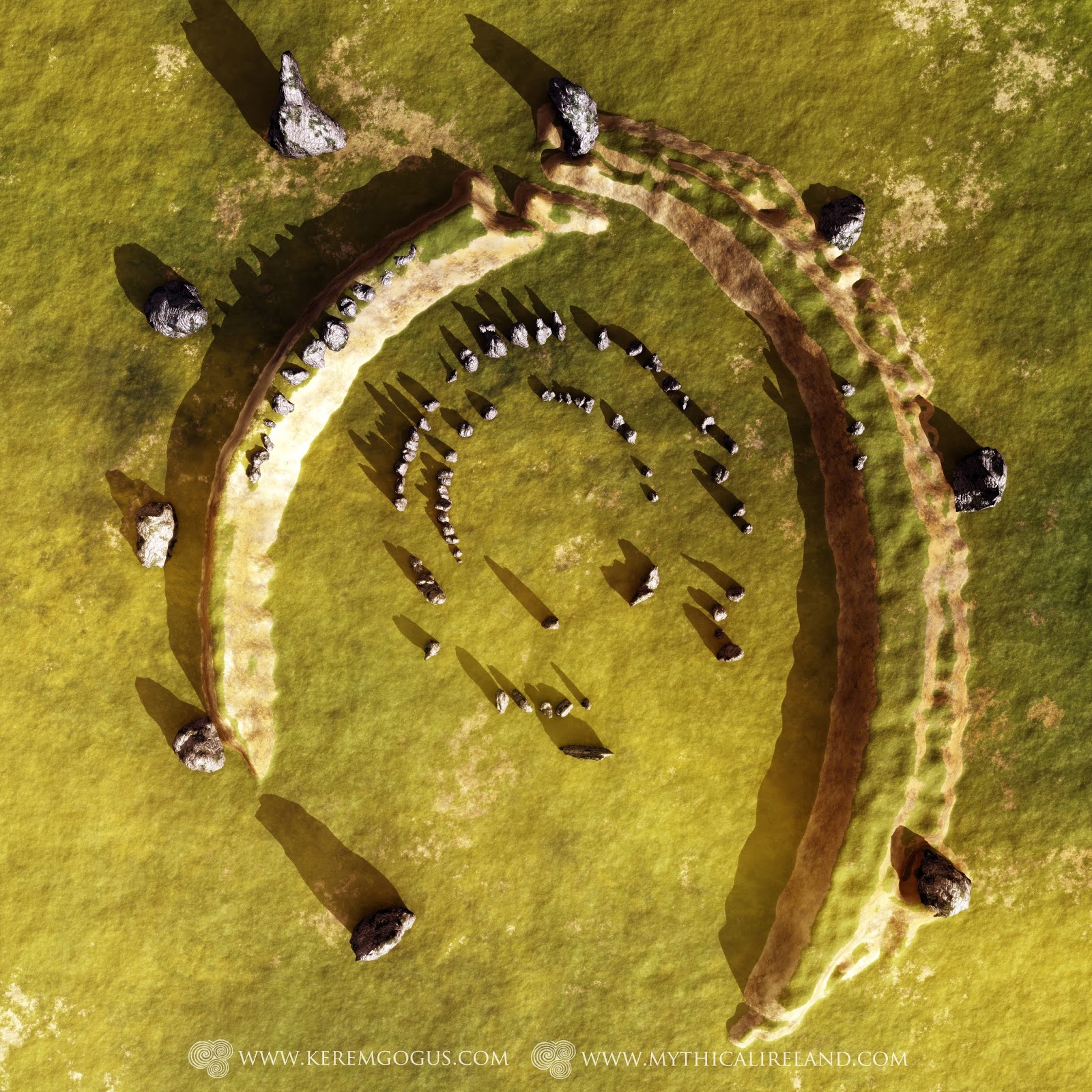
I am delighted to unveil new 3D-generated images showing Ireland's Stonehenge as it might have looked, created by 3D artist Kerem Gogus. These new images are based upon the only known depiction of a lost monument - a magnificent structure that probably dated to the Stone Age and could be considered Ireland's equivalent of Stonehenge - sadly now destroyed. The only drawing of this great embanked structure of concentric stone circles was made by the antiquarian and astronomer Thomas Wright, in the 1740s. Since then, the monument was destroyed, such that it was thought to have been lost completely until its "footprint" was found on an aerial photo of the Carnbeg area outside Dundalk, Co. Louth, in 1988.

The monument at Carnbeg brought to
life by in this new image by Kerem Gogus.
With only Wright's drawing to go on, Kerem made a couple of images about a decade ago showing what the stone monument might have looked like. But this week, following my revelation that some of the largest stones of the monument might actually be buried beneath the soil where they once stood, the Dundalk Democrat newspaper wanted to do an article about this discovery. Their reporter Ian Cameron contacted Kerem and he agreed to make new images, which give us the first conceptual overview in high resolution of how this monument might have looked if we could transport ourselves back in time. The images give us a unique glimpse at a unique monument. As a result of Kerem's fantastic work, we are able to visualise this once dramatic man-made construction.

The monument consisted of two concentric stone circles surrounded by an embankment with a ring of huge stones outside.
Here is an extract from the article in this week's Dundalk Democrat newspaper about the monument:

Thomas Wright's 18th century drawing
of the monument.
While doing research over the years, he [Anthony] read that some of the smaller stones were taken away and used as gate posts. He believes it should be possible to locate even some of these in the area. Old stone gate posts are easy to spot and quite rare these days. Other smaller stones were sadly broken up to be used as material for roads. The Armagh road (now known as the R177) effectively cut through the site.
“The road was not there in the 1740s when Wright made his drawing. As far as I can ascertain, this road was built in the 1750s (maybe some of your readers might have more information about the exact date of construction?) and would undoubtedly have led to the part destruction of the monument.
Dundalk Democrat's article.  
“For years, I've believed that all of the stones were either removed or broken up. But I've discovered a source (Bassett's Louth Directory from 1886) that says some of the larger monoliths (all but one) were buried: ’Most of the rest were dropped into holes sunk behind them, and covered at a sufficient depth to escape the plough’. For me, that's very exciting news. It means there's a possibility that the largest stones - at least some of them - are still there. It might be possible, using archaeology, to ascertain how many are still there, and there's even the tantalising possibility of discerning potential solar and lunar alignments of the site, which was described in the early 20th century by historian Henry Morris as having been an ancient 'school of astronomy'."
Anthony also believes the site could present a viable and successful tourist attraction for Dundalk once it has been fully investigated and potentially restored.

Another of Kerem Gogus's wonderful new 3D images showing what Ireland's Stonehenge probably looked like.