Showing posts with label river. Show all posts

Saturday, 22 April 2017

The House of Cleitech and Rosnaree: on the trail of the ancestors, crossing the ancient ford of the Boyne

In ancient times, long before stone bridges, the places where you crossed rivers were called fords. These were generally shallow parts of the river, sometimes stony, where one could expect to be able to walk or wade across in general safety, except when the river was in full torrent.

Ironically, there is no modern bridge across the River Boyne between Slane and Oldbridge – around the whole Bend of the Boyne – except for the pedestrian footbridge that is used by visitors to Knowth and Newgrange to access their buses from the visitor centre. However, in the olden days there were fording points along the Boyne, and one in particular that may have been where an ancient road from Tara crossed the river as it headed north.

Aerial view of the Boyne at Rosnaree showing (right) the old mill house and (arrowed) the ford.

This road was the Slighe Midhluachra, and it crossed the Boyne very near to the old mill house which still stands at Rosnaree. The ford was a paved ford, and was in regular use until the early years of the 20th century(1). Elizabeth Hickey, writing a half century ago, says this of the ford:
This was the Áth na Bóinne of the ancients. Near here Mananan, son of Lir, tied up his magic boat, the Ocean-Sweeper, the craft which knew his thoughts; here came the Sons of Turenn to borrow it in order to pursue their quest. Across this ford the builders of the great tombs, which tourists see today, passed to and from their work. Milesian fleets rowed past these tombs to battle with De Danaan magic. Warriors from the North descended to the ford, King Conchubar with Cuchulainn and his army, to fight at Rosnaree. St. Patrick and his followers passed to Slane.
The Boyne at Rosnaree, looking downstream towards the ford - Áth na Bóinne.

In ancient times of course, rivers and watercourses formed the only effective transport network. The builders of Newgrange, Knowth and Dowth knew this. They brought huge stones, many weighing three tonnes and more, up the Boyne on barges. However, they did not haul these stones beyond the shallow waters of the Boyne at Áth na Bóinne. It is likely that they landed much further east, somewhere in the vicinity of the lands that now form part of Dowth Hall, and hauled their stones from there. (The journey from that landing spot to Newgrange is a very arduous one. I might cover that in a future blog post).

The ford of Rosnaree was paved, i.e. artificially augmented with stones placed by people so as to raise the river bed and provide a more solid causeway across which the crossing could be made. The owners of the mill house in the middle of the 20th century were the Johnsons. Mr. Johnson told Elizabeth Hickey about the ford, "of travellers on horseback, travellers on foot, and hay-carts passing over, and men at work to keep it paved, not so very long ago".(2)

The ford marked on an old Ordnance Survey map. (Click to enlarge)

The precise location of the ford is still known, of course, not only because it is pinpointed on the older OS maps, but because a crossing is still possible in modern times, as pointed out locally, and indeed the rocks that undoubtedly form the augmented crossing cause the surface water of the river to rise and ripple over them.(3) 

Close by to the ford of the Boyne at Rosnaree is a place anciently called the House of Cletty (spelt variously as Cletigh, Cleiteach, Cleitech and Cletech, among others). Cleitech is said to have been the place where King Cormac Mac Art died after choking on a salmon bone, something that is very interesting because of Cleitech's proximity to Rosnaree and the Boyne, and the locality of Fiacc's Pool, where Fionn Mac Cumhaill and Finnegas were said to have caught the Salmon of Knowledge.

For a long time there was some mystery as to where Cleitech was located. The antiquarian William Wilde (father of Oscar Wilde) suggested it might have been at Clady, near Bective, south of Navan.(4) O'Donovan, in his notes on the Annals of the Four Masters, placed it "near Stackallen Bridge, on the south side of the Boyne."(5) Both were wrong. O'Donovan was closer, but Stackallen is several miles upstream from Rosnaree, west of Slane. It was Elizabeth Hickey who finally pinpointed its location through "considerable research"(6) and a healthy dose of doggedness. Here is her own account of the matter, based on her reading of the various myths and manuscripts. It is an excellent piece of detective work:
The Táin tells us that Cuchulain, when he went to woo Emer, descended to the Boyne on its lower reaches, between the Brugh of Oengus [Newgrange] and the Sidhe of Bresal to the west, and crossed the river between the houses of Cleitech and Fessi. From the story of the death of King Cormac we know that Cleitech was on the southern bank and was likely to have been near to Rosnaree, certainly not too far below the ford, for Cormac's bier was carried from the House of Cleitech to the river and borne by the river down to Rosnaree. Another story tells us of autumn games held between Newgrange and the House of Cleitech, and from these games and young folk ran to Knowth. The story of the death of Muirchertach gives us more detailed topography – the House of Cleitech was above the Boyne and above the green-topped Brugh; a glen lay to the south of the house; the grave of Muirchertach was to the north-east, according to another poem... There is only one spot on the map which fulfills all the conditions and this is the plateau-like elevation where Rosnaree House stands today.(7)
Síd in Broga (Newgrange) viewed from the Boyne at Rosnaree, near Cleitech.

Whatever the House of Cletty might have been, it is gone now. Its earliest mention as a house above the Boyne is in the Táin. One can imagine it might have been an Iron Age ringfort, something the Irish would have called a rath or a lios. But because it was the abode of kings (Muirchertach was the last king to live there), it might have been something more special, like a multivallate fort.(8) The Edwardian mansion of Rosnaree House is the most likely location of Cleitech, according to Hickey. The house is situated high above the river and from the terrace upon which it sits a great deal of the area can be seen, and there are views across to Knowth and Newgrange. According to archaeologist Geraldine Stout, a 14th/15th century reference "indicates that Cleitech lay near the Síd in Broga (Newgrange) and opposite Knowth".(9)

What might be the meaning of this name, Cleitech?

In a dialogue between Cúchulainn and his lover Emer, in the Táin Bó Cuailnge, Cúchulainn refers to a journey and masks the locations with obscure references, including: "over the Marrow of the woman Fedelm, between the Boar and His Dam", "That is, between Cleitech and Fessi. For Cleitech is the name for a boar, but it is also the name for a king, the leader of great hosts, and Fessi is the name for a great sow of a farmer's house."(10)

The old mill house at Rosnaree, close to Áth na Bóinne, the ancient ford across the Boyne.

Pigs and boars are prominent in Irish mythology. Long before the arrival of the builders of Newgrange and the neolithic farming revolution that saw the introduction of cows, wild boar was part of the staple mesolithic diet.(11) Pigs are plentiful in myth too. Lugh Lamhfada's father, Cian, took the shape of a wild pig to try to avoid the attention of the sons of Tuirenn. Diarmuid, one of the greatest warriors of the Fianna, was gored by a wild boar and consequently died. He was later brought to Newgrange by Oengus an Broga, "to put aerial life in him so that he will talk to me every day".(12)

But there is, perhaps, another meaning for Cleitech that makes sense in the context of a paved ford across the Boyne. In Shaw's dictionary, there is a word Cleitach which means "full of rocks", and a similar word, Cleitadh, meaning "a ridge of rocks in the sea".(13)

Whatever its meaning, Cleitech was an important place, although its house is long gone. However, the area around the ford at Rosnaree and the eminence upon which the House of Cletty once sat retain an ancient feel, and it's not difficult to see how the file (poet) or the draoi (druid), who might have drawn great inspiration from being close to the flowing waters of the Boyne, might have felt himself in heaven in these places.
...from just such ancestral visions the stuff of ancient history was made. This gentleman knew the river as the men of old, the number of the cygnets with the swans, the way the salmon ran, where lay the deep pool which must have been Linn Feic, the fox's way, the badgers' earth, the sunny sheltered place, a likely spot for hermitage. If Cleitech has disappeared, its environs remain unchanged – Cuchulain could cross the river today, and thinking of Emer, see nothing of the twentieth century but a slight untidiness of overgrowth.(14)
Rosnaree House (left), the most likely location of the ancient Cleitech, overlooking the Boyne.

Footnotes:
(1) Holten, Anthony (2017), The River Boyne, p.527. See also Hickey, Elizabeth (1966), I Send My Love Along the Boyne, p.9.
(2) Hickey, op. cit, p.9.
(3) The present owners of the old mill house, the Heise family, showed me the location of these rocks.
(4) Wilde, William (1849) [2003], The Beauties of the Boyne and Blackwater, p.116.
(5) O'Donovan, John (translator and editor) (1854), Annals of the Kingdom of Ireland by the Four Masters, Vol. I., pp.115-116.
(6) Hickey, op. cit., p.65.
(7) Hickey, op. cit., p.66.
(8) This, of course, is mere speculation on my part.
(9) Stout, Geraldine (2002), Newgrange and the Bend of the Boyne, Cork University Press, p.68.
(10) Lady Gregory, Cúchulainn of Muirthemne, p.353.
(11) Mallory, J.P. (2013), The Origins of the Irish, Thames & Hudson, pp.44-45.
(12) O'Kelly, Michael J. (1982), Newgrange: Archaeology, Art & Legend, p.43. This is cited from Ni Sheaghdha, N., (1967), Tóruigheacht Dhiarmada agus Ghráinne.
(13) Shaw, Rev. William (1780), Galic and English Dictionary, Volume 1.
(14) Hickey, op. cit., p.68. Hickey was here speaking with the then owner of Rosnaree House.

Tuesday, 11 April 2017

Up close with the Rosnaree Sheela-na-gig

I was very fortunate to have been given an opportunity to see and photograph an enigmatic and fascinating relic of Ireland's past in recent days. I had long known that once upon a time there was a Sheela-na-gig built into the wall of the old mill house at Rosnaree on southern bank of the River Boyne.

An old photo showing the Sheela-na-gig in place in the wall of the mill. Photo courtesy Barbara Heise.

About quarter of a century ago the ancient stone-carved figure was removed from its place in the wall of the mill for safekeeping. Before that, it had been whitewashed over so many times that it was becoming difficult to see its features.

The owners of the old mill, Georg and Barbara Heise, beautifully and lovingly converted the old structure into a modern habitable home. I was delighted to be given an opportunity by the Heise family to examine and indeed take photos of the Sheela-na-gig.

You might ask what a Sheela-na-gig is. They are "female exhibitionist carvings found on walls, abbeys, convents, churches, pillars and other structures in Ireland, England, Scotland and Wales, as well as in other parts of Europe. They come in many different shapes and sizes, but all share the same characteristic of a prominent and often enlarged genitals, often held open by the figure's hands. Most date from the middle ages."(1)

There are various theories as to what their intended meaning or purpose was, but we simply don't know for sure. Some suggest they were fertility figures, and that touching them was considered a blessing for assured pregnancy. Others say the fact they were often positioned on the walls of churches meant they served as a grotesque warning against the "sins of the flesh". Is the Sheela-na-gig supposed to represent a goddess? Or a crone/hag, like the cailleach?

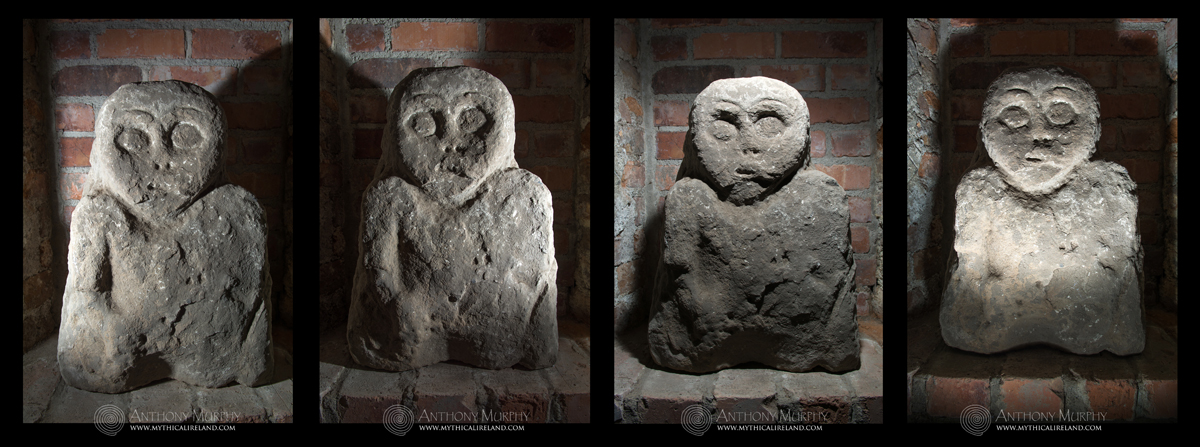
Anyway, regardless of the theories, they are indeed fascinating. Here is a montage of photos I took of the Rosnaree Sheela. In order to capture as much of the detail as possible, I used a remote flash and illuminated the figure from left, right, above and below. Click the image to see a larger version.

Four views of the Sheela-na-gig, illuminated from the left, right, above and below.

Here's a description from the Sites and Monuments Record (SMR) taken from the Archaeological Inventory of County Meath: "Sheela-na-gig now in private possession. Figure formerly built into wall beside door of mill that was not its original location. Removed from wall of mill and kept safe in store. Described by Freitag as a figure, ‘crudely carved on irregular stone slab; widest at bottom part which is cut straight, allowing figure to sit firmly on ground. Elongated, deeply hollowed out groove in crown of head (presumably for libations) further indication of figure originally free-standing. Left side defaced, and some damage also to chin, right forearm, right foot and lower part of leg. Large head, no ears, big owl-like eyes with eyebrows, clearly marked nostrils, jagged incision indicating mouth and possibly teeth. Four striations on right cheek running down to side of slab. No neck or breasts, but clearly marked navel. Right arm reaches under leg which is widely splayed, but no hands or fingers traceable. Genitals indicated by deep semi-circular depression’ (Freitag 2004, 140)."(2)

Recently, a link has been suggested between these grotesque Sheela-na-gig figures and the wife of Saint Patrick, who was called Sheela. The scholar who suggested that link, UCC folklorist Shane Lehane, says the following of the Sheela-na-gigs:
Sheela-na-Gig is a basic medieval carving of a woman exposing her genitalia. These images are often considered to be quite grotesque. They are quite shocking when you see them first.  Now we look at them very much as examples of old women showing young women how to give birth. They are vernacular folk deities associated with pregnancy and birth.

I wish to express my thanks again to the Heise family for making me so welcome and for allowing me the opportunity to see this rare and fascinating relic of the past.

A photo of the old mill house at Rosnaree during winter floods a few years ago.

References:
(1) Sheela-na-gig theories by Tara McLoughlin.
(2) http://webgis.archaeology.ie/historicenvironment/

Friday, 13 January 2017

All the dead kings came to me - Francis Ledwidge and the legend of the sleeping horsemen of Rosnaree

There's a poem by Francis Ledwidge that I really love. Ledwidge was born at Slane and died in the Great War in 1917 at the age of 29. He loved the Boyne Valley, and shortly before he died he wrote of his great longing for home in a letter to fellow poet Katherine Tynan:

Francis Ledwidge
"I want to see again my wonderful mother, and to walk by the Boyne to Crewbawn and up through the brown and grey rocks of Crocknaharna. You have no idea of how I suffer with this longing for the swish of the reeds at Slane and the voices I used to hear coming over the low hills of Currabwee. Say a prayer that I may get this leave, and give us a condition my punctual return and sojourn till the war is over."

Unfortunately, he never came home. He and five others were killed when a shell exploded beside them at the Battle of Ypres.

The Boyne Canal and River at Staleen at dusk, looking upstream towards Rossnaree (on the left).


One of his poems, The Dead Kings, interests me greatly.

All the dead kings came to me
At Rosnaree, where I was dreaming,
A few stars glimmered through the morn,
And down the thorn the dews were streaming.

And every dead king had a story
Of ancient glory, sweetly told.
It was too early for the lark,
But the starry dark had tints of gold.

I listened to the sorrows three
Of that Eire passed into song.
A cock crowed near a hazel croft,
And up aloft dim larks winged strong.

And I, too, told the kings a story
Of later glory, her fourth sorrow:
There was a sound like moving shields
In high green fields and the lowland furrow.

And one said: ‘We who yet are kings
Have heard these things lamenting inly.’
Sweet music flowed from many a bill
And on the hill the morn stood queenly.

And one said: ‘Over is the singing,
And bell bough ringing, whence we come;
With heavy hearts we’ll tread the shadows,
In honey meadows birds are dumb.’

And one said: ‘Since the poets perished
And all they cherished in the way,
Their thoughts unsung, like petal showers
Inflame the hours of blue and grey.’

And one said: ‘A loud tramp of men
We’ll hear again at Rosnaree.’
A bomb burst near me where I lay.
I woke, ’twas day in Picardy.


Rosnaree (more often spelt Rossnaree these days) is on the southern bank of the Bend of the Boyne, overlooking the famous Fiacc's Pool, where Fionn Mac Cumhaill is said to have caught the Salmon of Knowledge. It is close to the river ford (áth) which would have been the main crossing point over the Boyne in ancient times. It is the place where the Boyne river swelled up so that Cormac Mac Art's body could not be brought to be buried at Brug na Bóinne.

I wonder, when reading some of the lines of Ledwidge's poem, whether it is perhaps infused with elements of a familiar legend from Rosnaree, one that might involve dead kings and the spectre of a loud tramp of men returning to haunt its woods. Being a native of the area, Ledwidge would have undoubtedly been familiar with some of its stories.

There is a legend about Rosnaree which tells of sleeping soldiers. It is a familiar story, being similar to that told about Garrett's Fort(1) at Hacklim, outside Ardee in Co. Louth.

Rossnaree and the River Boyne from Bing Maps.

The Rosnaree version of the story talks about a man who encountered a light at a fort near Rosnaree, close to the Boyne. He entered into the fort to find a lot of bags hanging on the walls and one of the bags had a sword stuck in it. This story was recounted to a collector from the National Folklore Collection in 1938 by Navan resident James Neill (aged 74), who in turn had heard the tale from an elderly gentleman called Johnny Murray:
He went over and he was lifting up the sword and according as he was lifting it there was a man's head lifted up from this big bag and a horse along with him, and he was riding the horse, and as according as he drew out the sword there were horsemen rising all around the wall. They were nearly clear out of where they were and he got afeerd and he let the sword drop back in, and as soon as he did he was told, 'Go home, you coward.'  I disremember the regiment he'd have lifted out of prison if he lifted up the sword altogether.(2)(3)

Legends of a sleeping army waiting for a hero to come and rouse them for some great battle are present in other parts of Ireland too (such as at The Curragh, Co. Kildare, and Lough Gur in Limerick). Gearóid Iarla (Earl Garrett, Gerald) is sometimes the one who is the chief of the chthonic army. At Hacklim, some versions say it is Fionn Mac Cumhaill. The messianic theme of the legend in its various forms is overtly political, the clear premise being that a great leader from the past will return, from a supernatural subterranean domain, leading a great army to restore glory to Ireland. In the context of a country under the sway of foreign rule and oppression, it is no wonder that such tales might have been commonplace in Ireland.

The rousing of the army will happen because a prophesied hero (those who tried and failed are invariably referred to in less than favourable terms, such as "coward") will pull a sword out of a wall or a stone or a bag. If the sword in the stone sounds familiar, think of King Arthur and Excalibur! The notion of a hero or king sleeping in a cave can be found all over Europe and even further afield. It is so familiar in folklore that it is referred to as the "king in the mountain" motif and has been classified in the Aarne-Thompson system of folktale motifs.(4)(5)

Ledwidge's opening lines, "All the dead kings came to me At Rosnaree, where I was dreaming" are suggestive that he is familiar with that location's mythic and perhaps even historic significance. Perhaps the dead High King Cormac Mac Airt was one of those of whom he writes.

"There was a sound like moving shields In high green fields and the lowland furrow." Was Ledwidge, perhaps, describing the sound of the enchanted army of Rosnaree being awakened?

"A loud tramp of men We'll hear again at Rosnaree." Granted, Ledwidge was in the battlefields of the Great War, and although he says he is dreaming at Rosnaree, the bomb wakes him to the reality that he is, in fact, in Picardy. Nevertheless, it's an interesting speculation that he was perhaps reflecting upon cultural aspects of his homeland. Rosnaree would have been visible just across the Boyne Valley from his home at Janeville, east of Slane. Interestingly, Rosnaree is a name that comes from the Irish Ros na Ríogh, meaning "wood of the kings".(6)

Had Francis Ledwidge heard the story of the sleeping army of Rosnaree, and did he incorporate it into The Dead Kings? One might never know.(7)

However, the final lines of his poem are sadly prescient. "A bomb burst near me where I lay." He was killed on July 31st, 1917.


References:
(1) http://www.mythicalireland.com/highman/garretts-fort.php
(2) Marsh, Richard (2013), Meath Folk Tales, The History Press Ireland, p.164.
(3) A similar version, from the same original source (Johnny Murray) can be found in the Schools' Collection here: http://www.duchas.ie/en/cbes/5008912/4966251/5106184
(4) https://en.wikipedia.org/wiki/King_in_the_mountain
(5) http://www.counter-currents.com/2011/08/the-mountain-kings/
(6) https://www.logainm.ie/en/38699?s=Rossnaree
(7) It must be pointed out here that I am not well versed in the life of Ledwidge, and have not researched it in any scholarly way. If it should transpire that someone has written of  Ledwidge's inspiration for The Dead Kings and can answer my speculation either positively or negatively, I will be duly obliged/embarrassed (delete as appropriate!)

Monday, 10 October 2016

The Milky Way in Irish mythology and folklore

The Milky Way has been known by several names and phrases in Irish mythology and folklore. Principal among its names seems to have been Bealach na Bó Finne, which means the Way of the White Cow. In this respect, it seems to have been regarded as a heavenly reflection of the River Boyne. A variant of this is Bóthar na Bó Finne, the Road of the White Cow. The goddess Bóinn's name is from and Find, meaning White Cow. In the Dindshenchas, we are told that the Boyne river was formed when she approached Nechtain's Well and it overflowed, washing her along the river, mutilating her, and finally carrying her out to sea where she was drowned. There, we are told, her lapdog Dabilla was turned into the Rockabill Islands. This is undoubtedly a creation myth.

The Milky Way (Bealach na Bó Finne) over the River Boyne (Abhainn Bó Finne).
There are other names and phrases for the Milky Way. These include:

Ceann Síne - Síne is "chain", and ceann is "head" or "chief", perhaps even an "end point". (An end point would be interesting with regards to the movement of the sun, moon and planets along the ecliptic, which intersects the Milky Way at two points in the sky. Perhaps one of these points was considered the place where the heavenly cycles began and ended?)

Síog na Spéire - the streak or stripe of the sky.

Earball na Lárach Báine - the tail of the white mare. In folklore, Láir Bhán is also a phrase for the moon. The Láir Bhán is considered by some to be an ancient sovereignty goddess. One old Samhain custom in Ireland involved the procession of the Láir Bhán (White Mare) from house to house. People would blow on cows' horns and the party was headed by a person dressed in a white robe or sheet who was known as the "White Mare".(1)

Mór-Chuing Argait - A name given for the Boyne in the Dinshenchas meaning "Great Silver Yoke", which might also have been a description of the Milky Way.

Smir Find Fedlimthi - the White Marrow of Fedlimid, also from the Dindshenchas poem Boand I.

Claí Mór na Réaltaí - the Great Fence/Ditch of the Stars.

Sgríob Chlann Uisnich - Track of the children of Uisneach.

This last one is contained in a beautiful folk memory, recalled in Scotland and in Nova Scotia but relating to an Irish myth (Deidre and the Sons of Uisneach) which appears to be the recounting of an ancient creation myth about the Milky Way. In this story, the Milky Way is known as Sgríob Chlann Uisnich. 

From Deirdre and the Lay of the Children of Uisne.(2)
It is not surprising to see the Milky Way described in conjunction with the swan. The constellation we know today as Cygnus may have been important to Stone Age astronomers and it appears to fly along the heavenly river.

In the Nova Scotia version of Deirdre and the Sons of Uisneach, the origin of the Milky Way galaxy is depicted as emerging from two trees as separated by a loch, as if to complete an arch between them.This episode is placed in the well-known Ulster tale if Deirdre, whose lover, Noíse, is one of the Children of Uisneach.
... the sons of Uisneach are killed in a great, unnamed battle, after which Deidire falls into the grave with the men. The bodies of the two lovers are exhumed and reburied on either side of the burial mound. Soon a tree grows from each grave and rises until the two join. This arouses a great deal of vengeful malice in an unnamed king, who orders that the trees be cut down. Soon another pair of trees grows and joins until the king has them cut down as well. This sequence of events recurs repeatedly until the king decides to have the bodies placed on either side of a loch, a distance too great for the trees to span. Between the trees a cluster of stars gathers in a light trail, Sgríob Chlann Uisnich [track of the Children of Uisneach].(3)


Sgríób Chlann Uisnich - the track of the Children of Uisneach - over the Dowth megalithc mound.

References:
(1) Paice MacLeod, Sharon (1960), Celtic Myth & Religion, p.175.
(2) Carmichael, Alexander (1914), Deirdre and the Lay of the Children of Uisne, Hodges, Figgis & Co., p.152.
(3) MacKillop, James (2006), Myths and Legends of the Celts, Penguin Books, p.292.


Tuesday, 31 May 2016

The Boyne river, Carl Jung and the reconciliation of the masculine and feminine elements of life

I've been reading a book about the life and influence of Carl Jung. One of the things that has struck me since I recently began to earnestly probe the life and work of this hugely influential individual - only within the six or seven months - is how I have managed to live this long without encountering his writing, and the tremendous influence he has had, not least upon our understanding of mythology, but of the collective unconscious and the archetypes that emerge from some sincere yet imponderable depth within us.

A most exciting book
Marie-Louise Franz's biography, 'C.G. Jung - His Myth in Our Time', was one of the most exciting things I've ever read, and now I am following up with Laurens van der Post's 1976 biography, 'Jung and the Story of our Time', which I have to admit I find equally enthralling. I have read a limited amount of Jung's own writing, but in not untypical fashion I sometimes find that an account of a person of such greatness by a third party - in both these cases people who were lucky enough to know Jung while he was alive - provides a fuller insight into not just their work, but their whole being.

In a similar vein, my prejudice towards the biographer, if it hadn't been immediately obvious, was manifested in the case of Nietzsche when I found myself underlining and highlighting many more passages in a Janko Lavrin biography of him than I did in Nietzsche's own work, 'Beyond Good and Evil'.

In many respects, I had already met Carl Gustav Jung, through the work of someone who has often been described as a Jungian disciple, Joseph Campbell. Campbell's work crossed into fields of common interest with my own researches into the myths of the Boyne Valley and Ireland, and indeed became firmly focused in my crosshairs when his discussion of a myth about Venus shining into Newgrange once in eight years set the hairs on the back of my neck all tingling in one of many great and exciting revelations that occurred while I was researching for 'Island of the Setting Sun'.

Campbell was, I now realise, a stepping stone on the crossing of a great river, towards an even more fertile land, inhabited by the thoughts and works of a person of such great standing in the human story that it can be suggested, even though subjectively, that he deserved to stand alone from the human race, deified perhaps by those of us who can only tread gently in his shadow, so great and yet gentle is his presence in the great work of understanding the sacred, and the symbol, and the myths of mankind, and indeed his participation in the great mystery of his own existence.

And so I followed by bliss, and my bliss led me to Newgrange, and thereafter to the works of C.G. Jung.

Van der Post's biography of Jung.
In his biography, van der Post discusses Jung's association with the Rhine, and how Jung believed that no-one could truly live without being in the presence of water, whether lake or river. The biographer believes it was a portentous event that Jung, born on the shore of Lake Constance, should four years later move close to Basle, where he spent 21 years in the presence of the great Rhine, "so that ... the presence of this great river ... was in and around his senses". But here, van der Post makes a stark observation:

"The Rhine is one of the great mythological rivers of the world, not yielding place to the other immense mythological rivers representing the searching and inquiring spirits of men and their cultures, such as the Ganges, the Nile, the Yellow River of China and so on. But unlike those rivers which appear as rivers of light, resolution and are full of a natural, maternal solitude for life, the Rhine is a dark, angry and outraged masculine stream ... It was as if the Rhine had its source in the heart of the darkness of European history."

How can one say that a river, a restless body of water flowing ceaselessly from source to sea, has gender? I thought immediately of the Boyne, which has never been too far from me, either physically or consciously, and its very feminine name, Bóinn, she who is the illuminated bovine goddess of some antiquity. The following words from van der Post made me somewhat glad that my local river, the river of my youth and that is ever-present in my story upon this earth, should have such a stark feminine association:

"Like Heine, I could not understand why it should make me feel sad when the tops of the hills above the Rhine sparkled in a long evening sunlight of summer. I wondered why the story of Lorelei should trouble me? ... Perhaps it was because the imagery evoked by Heine of the feminine being of irresistible beauty and siren song, combing out her hair of gold with a comb of gold, represented all the feminine values which European man, particularly German man, had rejected. German culture, embedded as it was in a civilisation almost entirely man-made, was deliberately and wilfully masculine." In fact, van der Post wrote, "the infinitely renewing and renewable moon that swings the sea of change and symbolises all that is eternally feminine in the spirit of man, by some ominous perversity ... was rendered into a fixed and immutable masculinity."

And I thought, upon reading all the above, that no-one who had lived by the shores of the Boyne river, having heard her gentle lappings or the incessant babbling of her salmon weirs, could ever go to war against another man, or tribe, or nation. Naively, perhaps, I thought that a feminine name and a feminine myth were enough to ensure that those of us who lived within hearing distance of the bright cow river had within our grasp some sense of the feminine aspect of ourselves, allowing it some balance with the masculine in order that some good human decency would prevail that would impel us not towards conflict with our brethern in the greater world, but towards some greater accord. The moon, I felt, was itself a bright wandering cow, and in my own work I had been satisfied that Bóinn represented more than just the river which has her name - she was river, but also moon and Milky Way.

The Boyne ... a river with a feminine identity and feminine mythology.

Ireland did not have a "father" identity (like Germany or Japan), rather being named Éire, after one of a triune of goddesses. We did not make war, but rather we suffered it, and often were the unnecessary victims or players in someone else's conflict, or someone else's incursions upon Éire's sovereignty. This is written indelibly into our mytho-historical story, exemplified in the Lebor Gabála, the Book of Invasions, which has been imprinted upon the very essence of our spirit as a people.

I thought of the poet Francis Ledwidge, who was born near Slane, high above the Boyne on its northern bank, and who died in the Great War at the age of 29. He wrote:

Francis Ledwidge
"All the dead kings came to me
At Rosnaree, where I was dreaming ...
And every dead king had a story
Of ancient glory, sweetly told...
I listened to the sorrows three
Of that Eire passed into song...
And one said: 'Since the poets perished
And all they cherished in the way,
Their thoughts unsung, like petal showers
Inflame the hours of blue and gray."


And when I stood by Bóinn's shore, beneath looming Rosnaree, the wood of the king, I watched in flame the grafted embers of that twilight vision, of cherished things that were no more than barely formed thoughts, flowing down in a stream from hills beyond sight. And there, glistening in a pool of Bóinn's tender making, the relinquished dreams of that Éire passed into song would be gloriously resuscitated by the ancient poet, a Ledwidge in the guise of Finegas the Wise, singing merrily by the shore in an Ireland that is more famous for song than sword.

And we could not make kings of Jung nor Ledwidge nor Finegas, for even as a king at Rosnaree, I was, in the words of Shirley, sceptered and crowned, yet I tumbled down, and in the dust I was equal made with the poor crooked scythe and spade.

Often have I stood by Bóinn's brooding waters in the blue hour of evening, after the sun's departure, and listened there for the sounds of those stories of ancient glory, sweetly told. I never realised how that unfathomable something within my deeper self could be so brilliantly exemplified in the symbolism and sound of water until I had spent many a lonely hour in her presence. 

And maybe from now on, lingering at Bóinn's border as I ponder incessantly at the edge of the unfathomable, I will tip my hat to the great C.G. Jung, whose whole work, in the words of van der Post, "was the rediscovery of the great feminine objective within the objective psyche of man, as to make possible as never before a reconciliation of the masculine and feminine elements in life."

Thursday, 28 April 2016

Dunmoe Castle with dramatic sky


The wonderful thing about April is that it brings these glorious days that are a photographer's dream - a mix of strong sunshine and dramatic skies and towering clouds. In this case, a distant cumulonimbus cloud looms over the ruins of Dunmoe Castle in the Boyne Valley.

http://bit.ly/MI-gallery
from Flickr http://flic.kr/p/GxhmBW

Tuesday, 26 April 2016

Almost 1.9 million sunsets since Newgrange was built


Almost one million, nine hundred thousand sunsets. If we take the date of 3150BC for the construction of Newgrange (which is the date favoured by archaeologists), then tonight's sunset in the Boyne Valley (pictured) would be the 1,886,632nd sunset since this great monument was built in the distant New Stone Age. Also pictured, directly under the setting sun, is a satellite mound known only as Mound B.

You can now purchase prints of my photos online: http://www.mythicalireland.com/gallery.php

Photo shared from Flickr http://flic.kr/p/Gd62CC

Wednesday, 20 April 2016

Boyne bridge and walkway at sunset


Another photo from last night's sunset. This is taken from the boardwalk that connects Drogheda with the nearby Battle of the Boyne heritage site at Oldbridge. This is a fantastic local amenity, used by hundreds of people to enjoy views of the Boyne Valley as they walk, jog and cycle out to Oldbridge and beyond.

Remember that you can now buy prints, canvas prints, framed prints, e-cards, postcards, and even direct downloads of my images at http://www.mythicalireland.com/gallery.php

from Flickr http://flic.kr/p/GoETpG

Saturday, 16 April 2016

The River Boyne at Ardmulchan


I walked one day adown the Boyne,
From Domnach-Mor to Slaine;
How rich the fields on every side,
In Cattle, wood, or grain.

The river flowed in summer pride,
And on its banks of green,
How many a noble ancient home
Seemed sent'nelling the scene.

I marked the salmon springing free,
Beneath the glittering fall;
I heard the cuckoo in the glen
Repeat her welcome call.

Vigilantius, from the Irishman.

from Flickr http://flic.kr/p/FoBkBV
See my images also on 500px

Monday, 4 April 2016

The Great Silver Yoke of the Boyne turns south at Townleyhall, overlooked by this wonderful viewing point


I wonder how many people throughout history might have viewed the mighty sweeping bend of the Boyne as she turns southwards at Oldbridge/Townleyhall from this great vantage point.  There is a pathway that leads up through the Townleyhall woods and suddenly you are on this precipitous edge, looking down over the dramatic curving Boyne. Its westward path is suddenly forced to the south, and then around to the southeast, as it heads for its magnificent sweep around the Brug na Bóinne monuments. Until the introduction of salmon weirs on the Boyne, the river was tidal at this point and further south. Here is a passage about the Boyne from the Metrical Dindshenchas:
From the bounds of goodly Meath
till she reaches the sea's green floor
she is called the Great Silver Yoke
and the White Marrow of Fedlimid.
Read more from the Dindshenchas here.

Not too far from this point are mounds which might have been part of the Brú na Bóinne complex. The area shown in the photo is highlighted in the top right corner of the Mythical Ireland Boyne Valley interactive map below:


Tuesday, 23 February 2016

The peeling of the bells that calls you to your ancient self

Some day, I would like to try to sail down the Boyne, all the way from Carbury well to Inver Colpa. I know it's likely not possible, but I'd like to do it anyway. And I think that, in the doing of it, in the navigating of the puny Boyne, and the streamy Boyne, and the mighty Boyne, I might have relived a drama encompassing the journey of life; not a linear life, flowing from beginning to end, but rather a cyclical life, one with no beginning and no end, just a constant flow from one form to the next.

The river Boyne near Brugh na Bóinne.
And I wonder, just by contemplating the journey of the eternal river, if perhaps I might enter eternity myself, on the strength of a thought. Before you were born, I knew you. Before you were the Well of Segais, you were a million raindrops. Before your ejaculation on the slopes of Sídhe Nechtain, you had been glorified on the slopes of Mount Fuji, and on Kilimanjaro you had been a spring of nimiety; on the Matterhorn you had been a darkling brook, and at Elbrus a frozen fountainhead.

Segais, the beginning and the end.
Segais, the Alpha and the Omega.

Bless me with your sanctifying waters, so that I might spring forth a river, a mighty body of water whose end cannot be known. Cry me a river – not a river of sighs, or of broody reflection. Become Boyne, and give birth to a multitude of almighties, so that not one god, but a thousand, can become deified in your pools of crystal absolution. And there, on your shores, John the Baptist and Finneces the Wise will immerse the poor in spirit so that they may have their inner eyes washed clean, and that they may see with perfect vision the cloigtheach beneath the waves.

The mystery belfry below, the one that chimes mysteriously from the bottom of the lake, or from the brooding sea in the evening, is not a stony bell-tower left standing from the time of Atlantis's destruction.  Rather, it is that mystical something that must be awakened within you, that peeling of the bells that calls you to your ancient self – the you that was alive before the first of the ancient palaces were built, the you that is potent in the very matter of the universe.

Come down and ring the bells with the monks of the submarine heaven, that realm that lies beneath the darkness of your unconscious, and there make music that will echo in the very caverns of the sídhe. Go down, and be a bell-ringer for the awakening of a multitude. Call the world to enlightenment with a chorus of sound and voice from the deep, and bring the unrestrained joy of that chthonic music to every ear and heart and soul.


In memory of John Moriarty.

Sunday, 7 February 2016

Some old names for the town of Drogheda in Irish myths and place name lore

My home town is today called Drogheda. The common accepted nomenclature of Drogheda says that it is derived from the Irish Droichead Átha, meaning "Bridge on the Ford". I've always been curious about that, mainly because a ford or crossing point is something that obviously pre-dates a bridge, so that the name seems to refer to two distinct and different methods of crossing the river. Before bridges were built, rivers were crossed at shallow places called fords, or indeed at shallow places where the crossing was augmented by some sort of stone causeway built along the river bed.1

A view of Drogheda with its bridge over the Boyne from a mid-18th Century
painting by Gabriele Ricciardelli (Highlanes Gallery)
An ancient ford of the Boyne at Rosnaree, several miles upstream of Drogheda, is marked on early OS maps. It might have been one of the principal crossing places of the Boyne in prehistory, and was possibly the place where the great northern road from Tara, the Slíghe Midluachra, passed through the Boyne Valley adjacent to the great monuments of Brúg na Bóinne.

The ancient ford of the Boyne at Rosnaree. (Source)

In 'Island of the Setting Sun - In Search of Ireland's Ancient Astronomers', Richard Moore and I presented evidence that the name of the Boyne river might have been inspired by the Milky Way, the great "river of the sky" and that the Boyne might have been considered its earthly counterpart.

Some of Drogheda's numerous bridges.
So I have this pet theory, and it's only a theory, without much foundation, that perhaps the old name of Drogheda does not mean "Bridge on the Ford", but maybe something like "Ford of the Wheel" - droichead being related to the word droch, which means "wheel".2 I've also seen it written somewhere (although I cannot immediately recall the source) that suggested the word droichead stems from droch representing the wheel-shaped arches of a bridge. My theory is that the "ford of the wheel" is the crossing point of the earthly Milky Way, the river Boyne. Indeed, another great wheel of the sky - the Zodiac, through which the sun, moon and planets journey through the sky - was recognised in earlier times by the Irish phrase rael-draoch, the "circle or wheel of the stars".3

Anyway, I digress. Enough of the pet theories and deviations from the main topic at hand, which is the ancient name of the town we call Drogheda today.

In prehistoric times, the area where Drogheda is situated today was likely known as Inber Colpa (spelt different ways, including Inbher Colptha). There are a couple of different stories accounting for the origin of this name. One of these says that it is named after the shin-bone (Colptha) of the great monster the Mata, which was said to have been slain by the men of Éireann at a mysterious stone near Newgrange in Brug na Bóinne. Another story says the name is accounted for by the death of the Milesian brother Colpa during their battle with the Tuatha Dé Danann, who caused a fierce tempest to blow up as the Milesians attempted to land at the Boyne. You can read more about these stories in Island of the Setting Sun. Inber is an Irish word that means "the meeting of the waters", or a harbour or estuary.

Of particular interest to my little investigation here, though, are a couple of names for Drogheda which I had not previously encountered. Droichead Átha and Inber Colpa are well attested, but much less well known but equally interesting are some other names which were apparently given to the town, or features in its vicinity, in times long ago.

In their recounting of a famous story called 'The Colloquy of the Old Men', Cross and Slover in their 1936 book 'Ancient Irish Tales' refer to the separate journeys of  Oisín (son of the celebrated Finn McCool) and Cailte, son of Crunnchu mac Ronain. After visiting Finn's old nurse, Oisin and Cailte separate, one going north to seek Oisín's mother, who is one of the Tuatha De Danann; the other moving south toward Tara:

... Oisin went to the fairy-mound of Uch Cletigh, where was his mother, Blai daughter of Derc Dianscothach; while Cailte took his way to Inber Bic Loingsigh which at present is called Mainister Droichid Atha (the monastery of Drogheda) from Beg Loigsech son of Arist that was drowned in it, that is, the king of the Romans' son, who came to invade Ireland; but a tidal wave drowned him there in his inber (river-mouth). He went on to Linn Feic (Fiacc's Pool), on the bright-streaming Boyne; southwards over the Old Mag Breg, and to the rath (stronghold) of Drum Derg, where Patrick mac Calpuirn was.

Mellifont Abbey. 
There are a few things that are interesting in this passage. We know that Fiacc's Pool is likely situated on the bend of the Boyne beneath Ros na Rí (Rosnaree) and was the celebrated place where Finneces caught the Salmon of Knowledge, from which Finn gained all his wisdom. The 'Inber Bic Loingsigh' which was better known as the Monastery of Drogheda, is a curious one indeed. Bic of Beg is probably the Irish word for small. Loingsigh could be a variant of loingeasach, meaning "abounding in ships or in fleets".4 In his 1997 book Conversing with Angels and Ancients: Literary Myths of Medieval Ireland, Joseph Falaky Nagy asserts that the Mainistir Droichit Átha referred to in the text is Mellifont, the first Cistercian monastery founded in Ireland (in 1142). Not being a scholar in medieval Ireland, I cannot argue with him. However, the location of Mellifont a number of miles northwest of Drogheda, on a smaller tributary of the Boyne called the river Mattock, means it is some distance removed from the river mouth where Beg Loingsech was apparently drowned.

The story of the mysterious drowning of Beg Loingsech is interesting indeed. There are obvious parallels here between Inber Bic Loinsigh and Inber Colpa. Bic Loinsigh was the son of the king of the Romans, who "came to invade Ireland", but a tidal wave drowned him at the river mouth. Colpa was a son of Mil, the king of Spain, and he was drowned somewhere near the mouth of the Boyne by a storm whipped up by the Dé Dananns while trying to land for the purpose of taking Ireland from them. The Milesians could also have said to be "abounding in ships"; many of them were destroyed in the Dé Danann tempest. The parallels between these stories are so striking that one cannot but draw the tentative impression that they are two versions of a single old mythic narrative involving the naming of the Boyne estuary.

Another obscure ancient name from Drogheda is mentioned all too briefly in O'Donovan's Ordnance Survey letters, and it would be interesting to see if further research into this name - and its variants - yields information of interest. Here is what O'Donovan says, after writing briefly about the name Droichet Atha:

There are other ancient names of it still retained by some persons. Sarsfield, whom we have mentioned on our former letters, says the ancient name of it was Ath Dhunruaidhe, and Jones says the ancient name of it was Dun Dubhruaidhe . . . Others say it was called Treda prior to it having got the denomination of Drogheda - if it was so-called, Treda seems to have been the first Anglicized name of it. Droichet atha (Droichet Atha) occurs in several places in the Annals of the Four Masters . . .5

Literally translated, Ath Dhun Ruaidhe would mean "the ford of the red fort" or something similar and Dun Dubhruaidhe would mean "the fort of black-red" or something to that effect. O'Donovan puts a footnote in for the Sarsfield and Jones references which asks the question "Are these names preserved in any document?" Regrettably, the answer would appear to be no.

NOTES:

1. Drochet can also refer to a causeway as well as a bridge. See DIL.
2. See Vallancey (referenced in Newgrange: Monument to Immortality) and also for droch = coach-wheel, see the Shaw Gaelic Dictionary.
3. Newgrange: Monument to Immortality, Anthony Murphy, 2012, p.92.
4. Shaw Gaelic Dictionary, p.358.
5. Louth Ordnance Survey Letters, Co. Louth Archaeological Journal Vols. IV, V & VI, p.92.

Sunday, 22 November 2015

The synchronicity of the swans

Recently I've found that my senses have come into sharp focus around certain mythical imagery associated closely with the Boyne Valley area. In my spare time, I'm doing some study and research which has taken me towards examining the metaphor and symbolism of myth. This has yielded interesting results. I explained to a friend this week how I seemed to be engaged in an interesting process of following "hunches" and "leads" and that this process almost always bears fruit.

When dealing with the area of science versus mysticism, I can, by and large, only deal with my own direct experiences and how they have forged my thoughts and beliefs around the whole question of the rational versus the esoteric. Currently, I am agnostic. The best and simplest definition of my agnosticism I can offer is this - I neither have proof in the existence of a god or an afterlife, or of other worlds and other realms of spirit or consciousness; nor do I have proof that they don't exist. I remain very open-minded. I am grateful for this open-mindedness. It prevents me from blindly following a path of enquiry without considering the alternatives. Recently, my work has focused on the alternatives.
The sun setting above Rosnaree overlooking the Boyne river.
I have been experiencing synchronicities - strange and wonderful coincidences and happenings - since the very beginning of my researches into myths and monuments years ago. I initially thought them to be what Richard Moore and I called "spooky coincidences" but over the years I've come to see them less as something to be scared of and more something to be enthralled and inspired by. My own experience has been that when a synchronicity occurs, it's like an affirmation that I'm on the right track with something.

But is all this just some sort of mystical woo? Is this just me indulging in some new age wishy-washy nonsense? I don't think so. And I'm glad to quote Philip Freund, a novelist, poet, short-story writer, documentary film writer, television dramatist and playwright as well as essayist, literary critic and anthropologist. Freund was a man described in his obituary as a "true polymath". If ever there was somebody who embodied the persona of the Samildánach - the many-gifted - it was Freund. Here's what Freund has to say about science and intuition, which brings us back to the subject in hand:

The history of science is filled with instances of noted workers in all fields who testify in their memoirs that a "hunch," a perhaps inexplicable ray of light, suddenly led them to a major discovery. Is it Newton under the apple tree, or Galvani watching his wife cook frogs' legs? Some of these invaluable "finds" seem to have been pure accidents . . . But what inspires the author of a scientific hypothesis to choose one route, one direction of approach, rather than another, when many offer themselves with equal persuasiveness to him or confront him with an equal opacity? Whence comes the "hunch," what directs the "ray of light," the seemingly lucky chance that without warning illuminates the right dark path to be followed?  (Myths of Creation, Peter Owen Publishers, [1964] (2003), p.280.

I was walking the dog on Friday night, going to collect my sons from football. As I walked along on a very cold, icy night (the first of this winter), I thought about all the research I've been doing lately and how it all seems to have produced fascinating insights. A great deal of this research work has surrounded stories about animals and mythic creatures. A great deal of it involved following hunches and intuition. And a great deal of it yielded interesting results. A thought came into my head, along these lines:

"You've really hit on something here, Anthony. This is the sweet spot".

Just as I thought that, I heard what might have been children's voices in the distance. I looked along the road, half expecting to see my sons and their friends coming towards me. But the road was deserted. There were no cars and no people at all, which is unusual because it's normally a very busy road.

Again I thought I heard a voice or two, but this time they were above me, so I looked up instinctively, and caught sight of a formation of eight whooper swans flying southwards, directly over my head.

The significance of this beautiful creature (for those of you unfamiliar with the myths of Newgrange) is that the whooper swan has been wintering at Newgrange for a long time - quite probably since before the monuments were built there 5,000 years ago. Some of the predominant myths about Newgrange, and the supernatural characters associated with it, involve swans. The most famous of these is the Aislinge Óenguso, the Dream of Angus Óg. See the Cygnus Enigma for more about the swan.

Were these eight swans among the first to arrive into the Boyne Valley for the winter of 2015? Every winter, thousands of whooper swans come to Ireland from Iceland, landing en masse in Donegal and then diverging into smaller groups to winter at various sites on the island. The area around Newgrange is an important wintering ground. It regularly sees more than 50 swans in winter, making it one of the predominant sites for the whoopers.

Just this afternoon I received an SMS text message from a friend of mine who keeps a close eye on things out in the valley. Over the past few winters he has been keeping me informed about the arrival and departure of the whooper swans. This is what I received from him today:

Whoopers at Knowth Anthony. About 8. Just arrived.

I smiled when I received it. And of course the first thing to come into my mind was the thought that perhaps these were the same eight that had flown over my head on Friday night . . .

So I feel inclined to continue following these lines of mythic research that are opening up before me. There is something in the mythology of the Boyne monuments that begs to be explored, deeply and extensively, and open-mindedly, because they are more than just stories. I believe they contain an essence of what the monuments were all about, and an insight into the mind of distant ancestors. Are these stories at all relevant today? Absolutely. They are a revelation - a vista into the soul itself, and I don't believe it's at all coincidental that this mythology has survived from time immemorial to tell a story to the people of today.

The process of mythic investigation has been an epiphany for me, a process of recondite introspection that has been at times both intimidating and riveting. It's brought me right into the centre of my own story on this planet . . . the reason I am here.

Sunday, 14 October 2012

Some recent pictures from Mythical Ireland

One of the replica cannons at the Oldbridge Battle of the Boyne visitor site.

 A riverside walk in Drogheda at Mell, along the river Boyne.

A stormy sea crashes into the rocks near Hook Head, Co. Wexford.

Sunday, 29 July 2012

Flowing water and colourful stones make for nice photos

Stones and flowing water . . . at Townley Hall, near Drogheda
Even with relatively short exposures, like a half a second, the moving
water takes on a misty look.

A stick and a leaf in the stream.

The stream is very shallow, only inches deep.