Showing posts with label Rosnaree. Show all posts

Saturday, 22 April 2017

The House of Cleitech and Rosnaree: on the trail of the ancestors, crossing the ancient ford of the Boyne

In ancient times, long before stone bridges, the places where you crossed rivers were called fords. These were generally shallow parts of the river, sometimes stony, where one could expect to be able to walk or wade across in general safety, except when the river was in full torrent.

Ironically, there is no modern bridge across the River Boyne between Slane and Oldbridge – around the whole Bend of the Boyne – except for the pedestrian footbridge that is used by visitors to Knowth and Newgrange to access their buses from the visitor centre. However, in the olden days there were fording points along the Boyne, and one in particular that may have been where an ancient road from Tara crossed the river as it headed north.

Aerial view of the Boyne at Rosnaree showing (right) the old mill house and (arrowed) the ford.

This road was the Slighe Midhluachra, and it crossed the Boyne very near to the old mill house which still stands at Rosnaree. The ford was a paved ford, and was in regular use until the early years of the 20th century(1). Elizabeth Hickey, writing a half century ago, says this of the ford:
This was the Áth na Bóinne of the ancients. Near here Mananan, son of Lir, tied up his magic boat, the Ocean-Sweeper, the craft which knew his thoughts; here came the Sons of Turenn to borrow it in order to pursue their quest. Across this ford the builders of the great tombs, which tourists see today, passed to and from their work. Milesian fleets rowed past these tombs to battle with De Danaan magic. Warriors from the North descended to the ford, King Conchubar with Cuchulainn and his army, to fight at Rosnaree. St. Patrick and his followers passed to Slane.
The Boyne at Rosnaree, looking downstream towards the ford - Áth na Bóinne.

In ancient times of course, rivers and watercourses formed the only effective transport network. The builders of Newgrange, Knowth and Dowth knew this. They brought huge stones, many weighing three tonnes and more, up the Boyne on barges. However, they did not haul these stones beyond the shallow waters of the Boyne at Áth na Bóinne. It is likely that they landed much further east, somewhere in the vicinity of the lands that now form part of Dowth Hall, and hauled their stones from there. (The journey from that landing spot to Newgrange is a very arduous one. I might cover that in a future blog post).

The ford of Rosnaree was paved, i.e. artificially augmented with stones placed by people so as to raise the river bed and provide a more solid causeway across which the crossing could be made. The owners of the mill house in the middle of the 20th century were the Johnsons. Mr. Johnson told Elizabeth Hickey about the ford, "of travellers on horseback, travellers on foot, and hay-carts passing over, and men at work to keep it paved, not so very long ago".(2)

The ford marked on an old Ordnance Survey map. (Click to enlarge)

The precise location of the ford is still known, of course, not only because it is pinpointed on the older OS maps, but because a crossing is still possible in modern times, as pointed out locally, and indeed the rocks that undoubtedly form the augmented crossing cause the surface water of the river to rise and ripple over them.(3) 

Close by to the ford of the Boyne at Rosnaree is a place anciently called the House of Cletty (spelt variously as Cletigh, Cleiteach, Cleitech and Cletech, among others). Cleitech is said to have been the place where King Cormac Mac Art died after choking on a salmon bone, something that is very interesting because of Cleitech's proximity to Rosnaree and the Boyne, and the locality of Fiacc's Pool, where Fionn Mac Cumhaill and Finnegas were said to have caught the Salmon of Knowledge.

For a long time there was some mystery as to where Cleitech was located. The antiquarian William Wilde (father of Oscar Wilde) suggested it might have been at Clady, near Bective, south of Navan.(4) O'Donovan, in his notes on the Annals of the Four Masters, placed it "near Stackallen Bridge, on the south side of the Boyne."(5) Both were wrong. O'Donovan was closer, but Stackallen is several miles upstream from Rosnaree, west of Slane. It was Elizabeth Hickey who finally pinpointed its location through "considerable research"(6) and a healthy dose of doggedness. Here is her own account of the matter, based on her reading of the various myths and manuscripts. It is an excellent piece of detective work:
The Táin tells us that Cuchulain, when he went to woo Emer, descended to the Boyne on its lower reaches, between the Brugh of Oengus [Newgrange] and the Sidhe of Bresal to the west, and crossed the river between the houses of Cleitech and Fessi. From the story of the death of King Cormac we know that Cleitech was on the southern bank and was likely to have been near to Rosnaree, certainly not too far below the ford, for Cormac's bier was carried from the House of Cleitech to the river and borne by the river down to Rosnaree. Another story tells us of autumn games held between Newgrange and the House of Cleitech, and from these games and young folk ran to Knowth. The story of the death of Muirchertach gives us more detailed topography – the House of Cleitech was above the Boyne and above the green-topped Brugh; a glen lay to the south of the house; the grave of Muirchertach was to the north-east, according to another poem... There is only one spot on the map which fulfills all the conditions and this is the plateau-like elevation where Rosnaree House stands today.(7)
Síd in Broga (Newgrange) viewed from the Boyne at Rosnaree, near Cleitech.

Whatever the House of Cletty might have been, it is gone now. Its earliest mention as a house above the Boyne is in the Táin. One can imagine it might have been an Iron Age ringfort, something the Irish would have called a rath or a lios. But because it was the abode of kings (Muirchertach was the last king to live there), it might have been something more special, like a multivallate fort.(8) The Edwardian mansion of Rosnaree House is the most likely location of Cleitech, according to Hickey. The house is situated high above the river and from the terrace upon which it sits a great deal of the area can be seen, and there are views across to Knowth and Newgrange. According to archaeologist Geraldine Stout, a 14th/15th century reference "indicates that Cleitech lay near the Síd in Broga (Newgrange) and opposite Knowth".(9)

What might be the meaning of this name, Cleitech?

In a dialogue between Cúchulainn and his lover Emer, in the Táin Bó Cuailnge, Cúchulainn refers to a journey and masks the locations with obscure references, including: "over the Marrow of the woman Fedelm, between the Boar and His Dam", "That is, between Cleitech and Fessi. For Cleitech is the name for a boar, but it is also the name for a king, the leader of great hosts, and Fessi is the name for a great sow of a farmer's house."(10)

The old mill house at Rosnaree, close to Áth na Bóinne, the ancient ford across the Boyne.

Pigs and boars are prominent in Irish mythology. Long before the arrival of the builders of Newgrange and the neolithic farming revolution that saw the introduction of cows, wild boar was part of the staple mesolithic diet.(11) Pigs are plentiful in myth too. Lugh Lamhfada's father, Cian, took the shape of a wild pig to try to avoid the attention of the sons of Tuirenn. Diarmuid, one of the greatest warriors of the Fianna, was gored by a wild boar and consequently died. He was later brought to Newgrange by Oengus an Broga, "to put aerial life in him so that he will talk to me every day".(12)

But there is, perhaps, another meaning for Cleitech that makes sense in the context of a paved ford across the Boyne. In Shaw's dictionary, there is a word Cleitach which means "full of rocks", and a similar word, Cleitadh, meaning "a ridge of rocks in the sea".(13)

Whatever its meaning, Cleitech was an important place, although its house is long gone. However, the area around the ford at Rosnaree and the eminence upon which the House of Cletty once sat retain an ancient feel, and it's not difficult to see how the file (poet) or the draoi (druid), who might have drawn great inspiration from being close to the flowing waters of the Boyne, might have felt himself in heaven in these places.
...from just such ancestral visions the stuff of ancient history was made. This gentleman knew the river as the men of old, the number of the cygnets with the swans, the way the salmon ran, where lay the deep pool which must have been Linn Feic, the fox's way, the badgers' earth, the sunny sheltered place, a likely spot for hermitage. If Cleitech has disappeared, its environs remain unchanged – Cuchulain could cross the river today, and thinking of Emer, see nothing of the twentieth century but a slight untidiness of overgrowth.(14)
Rosnaree House (left), the most likely location of the ancient Cleitech, overlooking the Boyne.

Footnotes:
(1) Holten, Anthony (2017), The River Boyne, p.527. See also Hickey, Elizabeth (1966), I Send My Love Along the Boyne, p.9.
(2) Hickey, op. cit, p.9.
(3) The present owners of the old mill house, the Heise family, showed me the location of these rocks.
(4) Wilde, William (1849) [2003], The Beauties of the Boyne and Blackwater, p.116.
(5) O'Donovan, John (translator and editor) (1854), Annals of the Kingdom of Ireland by the Four Masters, Vol. I., pp.115-116.
(6) Hickey, op. cit., p.65.
(7) Hickey, op. cit., p.66.
(8) This, of course, is mere speculation on my part.
(9) Stout, Geraldine (2002), Newgrange and the Bend of the Boyne, Cork University Press, p.68.
(10) Lady Gregory, Cúchulainn of Muirthemne, p.353.
(11) Mallory, J.P. (2013), The Origins of the Irish, Thames & Hudson, pp.44-45.
(12) O'Kelly, Michael J. (1982), Newgrange: Archaeology, Art & Legend, p.43. This is cited from Ni Sheaghdha, N., (1967), Tóruigheacht Dhiarmada agus Ghráinne.
(13) Shaw, Rev. William (1780), Galic and English Dictionary, Volume 1.
(14) Hickey, op. cit., p.68. Hickey was here speaking with the then owner of Rosnaree House.

Tuesday, 11 April 2017

Up close with the Rosnaree Sheela-na-gig

I was very fortunate to have been given an opportunity to see and photograph an enigmatic and fascinating relic of Ireland's past in recent days. I had long known that once upon a time there was a Sheela-na-gig built into the wall of the old mill house at Rosnaree on southern bank of the River Boyne.

An old photo showing the Sheela-na-gig in place in the wall of the mill. Photo courtesy Barbara Heise.

About quarter of a century ago the ancient stone-carved figure was removed from its place in the wall of the mill for safekeeping. Before that, it had been whitewashed over so many times that it was becoming difficult to see its features.

The owners of the old mill, Georg and Barbara Heise, beautifully and lovingly converted the old structure into a modern habitable home. I was delighted to be given an opportunity by the Heise family to examine and indeed take photos of the Sheela-na-gig.

You might ask what a Sheela-na-gig is. They are "female exhibitionist carvings found on walls, abbeys, convents, churches, pillars and other structures in Ireland, England, Scotland and Wales, as well as in other parts of Europe. They come in many different shapes and sizes, but all share the same characteristic of a prominent and often enlarged genitals, often held open by the figure's hands. Most date from the middle ages."(1)

There are various theories as to what their intended meaning or purpose was, but we simply don't know for sure. Some suggest they were fertility figures, and that touching them was considered a blessing for assured pregnancy. Others say the fact they were often positioned on the walls of churches meant they served as a grotesque warning against the "sins of the flesh". Is the Sheela-na-gig supposed to represent a goddess? Or a crone/hag, like the cailleach?

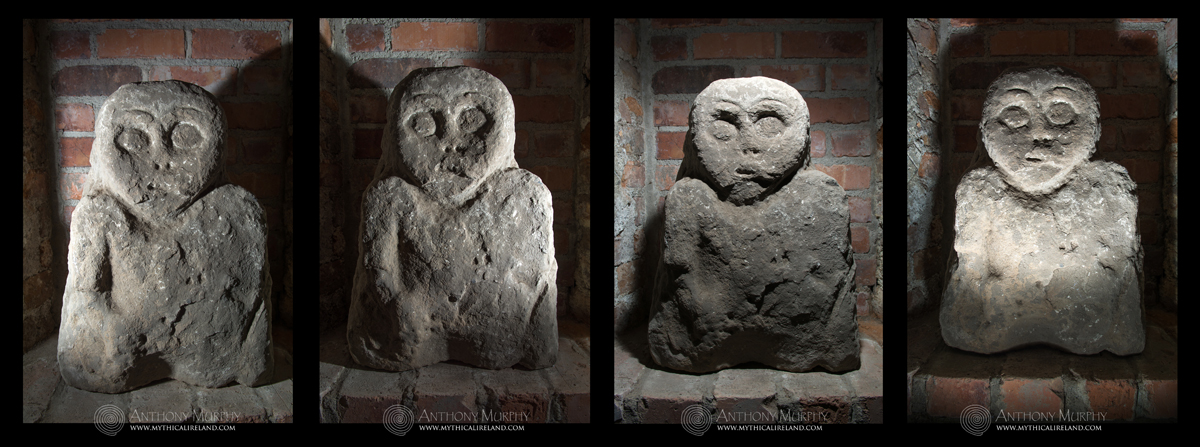
Anyway, regardless of the theories, they are indeed fascinating. Here is a montage of photos I took of the Rosnaree Sheela. In order to capture as much of the detail as possible, I used a remote flash and illuminated the figure from left, right, above and below. Click the image to see a larger version.

Four views of the Sheela-na-gig, illuminated from the left, right, above and below.

Here's a description from the Sites and Monuments Record (SMR) taken from the Archaeological Inventory of County Meath: "Sheela-na-gig now in private possession. Figure formerly built into wall beside door of mill that was not its original location. Removed from wall of mill and kept safe in store. Described by Freitag as a figure, ‘crudely carved on irregular stone slab; widest at bottom part which is cut straight, allowing figure to sit firmly on ground. Elongated, deeply hollowed out groove in crown of head (presumably for libations) further indication of figure originally free-standing. Left side defaced, and some damage also to chin, right forearm, right foot and lower part of leg. Large head, no ears, big owl-like eyes with eyebrows, clearly marked nostrils, jagged incision indicating mouth and possibly teeth. Four striations on right cheek running down to side of slab. No neck or breasts, but clearly marked navel. Right arm reaches under leg which is widely splayed, but no hands or fingers traceable. Genitals indicated by deep semi-circular depression’ (Freitag 2004, 140)."(2)

Recently, a link has been suggested between these grotesque Sheela-na-gig figures and the wife of Saint Patrick, who was called Sheela. The scholar who suggested that link, UCC folklorist Shane Lehane, says the following of the Sheela-na-gigs:
Sheela-na-Gig is a basic medieval carving of a woman exposing her genitalia. These images are often considered to be quite grotesque. They are quite shocking when you see them first.  Now we look at them very much as examples of old women showing young women how to give birth. They are vernacular folk deities associated with pregnancy and birth.

I wish to express my thanks again to the Heise family for making me so welcome and for allowing me the opportunity to see this rare and fascinating relic of the past.

A photo of the old mill house at Rosnaree during winter floods a few years ago.

References:
(1) Sheela-na-gig theories by Tara McLoughlin.
(2) http://webgis.archaeology.ie/historicenvironment/

Friday, 13 January 2017

All the dead kings came to me - Francis Ledwidge and the legend of the sleeping horsemen of Rosnaree

There's a poem by Francis Ledwidge that I really love. Ledwidge was born at Slane and died in the Great War in 1917 at the age of 29. He loved the Boyne Valley, and shortly before he died he wrote of his great longing for home in a letter to fellow poet Katherine Tynan:

Francis Ledwidge
"I want to see again my wonderful mother, and to walk by the Boyne to Crewbawn and up through the brown and grey rocks of Crocknaharna. You have no idea of how I suffer with this longing for the swish of the reeds at Slane and the voices I used to hear coming over the low hills of Currabwee. Say a prayer that I may get this leave, and give us a condition my punctual return and sojourn till the war is over."

Unfortunately, he never came home. He and five others were killed when a shell exploded beside them at the Battle of Ypres.

The Boyne Canal and River at Staleen at dusk, looking upstream towards Rossnaree (on the left).


One of his poems, The Dead Kings, interests me greatly.

All the dead kings came to me
At Rosnaree, where I was dreaming,
A few stars glimmered through the morn,
And down the thorn the dews were streaming.

And every dead king had a story
Of ancient glory, sweetly told.
It was too early for the lark,
But the starry dark had tints of gold.

I listened to the sorrows three
Of that Eire passed into song.
A cock crowed near a hazel croft,
And up aloft dim larks winged strong.

And I, too, told the kings a story
Of later glory, her fourth sorrow:
There was a sound like moving shields
In high green fields and the lowland furrow.

And one said: ‘We who yet are kings
Have heard these things lamenting inly.’
Sweet music flowed from many a bill
And on the hill the morn stood queenly.

And one said: ‘Over is the singing,
And bell bough ringing, whence we come;
With heavy hearts we’ll tread the shadows,
In honey meadows birds are dumb.’

And one said: ‘Since the poets perished
And all they cherished in the way,
Their thoughts unsung, like petal showers
Inflame the hours of blue and grey.’

And one said: ‘A loud tramp of men
We’ll hear again at Rosnaree.’
A bomb burst near me where I lay.
I woke, ’twas day in Picardy.


Rosnaree (more often spelt Rossnaree these days) is on the southern bank of the Bend of the Boyne, overlooking the famous Fiacc's Pool, where Fionn Mac Cumhaill is said to have caught the Salmon of Knowledge. It is close to the river ford (áth) which would have been the main crossing point over the Boyne in ancient times. It is the place where the Boyne river swelled up so that Cormac Mac Art's body could not be brought to be buried at Brug na Bóinne.

I wonder, when reading some of the lines of Ledwidge's poem, whether it is perhaps infused with elements of a familiar legend from Rosnaree, one that might involve dead kings and the spectre of a loud tramp of men returning to haunt its woods. Being a native of the area, Ledwidge would have undoubtedly been familiar with some of its stories.

There is a legend about Rosnaree which tells of sleeping soldiers. It is a familiar story, being similar to that told about Garrett's Fort(1) at Hacklim, outside Ardee in Co. Louth.

Rossnaree and the River Boyne from Bing Maps.

The Rosnaree version of the story talks about a man who encountered a light at a fort near Rosnaree, close to the Boyne. He entered into the fort to find a lot of bags hanging on the walls and one of the bags had a sword stuck in it. This story was recounted to a collector from the National Folklore Collection in 1938 by Navan resident James Neill (aged 74), who in turn had heard the tale from an elderly gentleman called Johnny Murray:
He went over and he was lifting up the sword and according as he was lifting it there was a man's head lifted up from this big bag and a horse along with him, and he was riding the horse, and as according as he drew out the sword there were horsemen rising all around the wall. They were nearly clear out of where they were and he got afeerd and he let the sword drop back in, and as soon as he did he was told, 'Go home, you coward.'  I disremember the regiment he'd have lifted out of prison if he lifted up the sword altogether.(2)(3)

Legends of a sleeping army waiting for a hero to come and rouse them for some great battle are present in other parts of Ireland too (such as at The Curragh, Co. Kildare, and Lough Gur in Limerick). Gearóid Iarla (Earl Garrett, Gerald) is sometimes the one who is the chief of the chthonic army. At Hacklim, some versions say it is Fionn Mac Cumhaill. The messianic theme of the legend in its various forms is overtly political, the clear premise being that a great leader from the past will return, from a supernatural subterranean domain, leading a great army to restore glory to Ireland. In the context of a country under the sway of foreign rule and oppression, it is no wonder that such tales might have been commonplace in Ireland.

The rousing of the army will happen because a prophesied hero (those who tried and failed are invariably referred to in less than favourable terms, such as "coward") will pull a sword out of a wall or a stone or a bag. If the sword in the stone sounds familiar, think of King Arthur and Excalibur! The notion of a hero or king sleeping in a cave can be found all over Europe and even further afield. It is so familiar in folklore that it is referred to as the "king in the mountain" motif and has been classified in the Aarne-Thompson system of folktale motifs.(4)(5)

Ledwidge's opening lines, "All the dead kings came to me At Rosnaree, where I was dreaming" are suggestive that he is familiar with that location's mythic and perhaps even historic significance. Perhaps the dead High King Cormac Mac Airt was one of those of whom he writes.

"There was a sound like moving shields In high green fields and the lowland furrow." Was Ledwidge, perhaps, describing the sound of the enchanted army of Rosnaree being awakened?

"A loud tramp of men We'll hear again at Rosnaree." Granted, Ledwidge was in the battlefields of the Great War, and although he says he is dreaming at Rosnaree, the bomb wakes him to the reality that he is, in fact, in Picardy. Nevertheless, it's an interesting speculation that he was perhaps reflecting upon cultural aspects of his homeland. Rosnaree would have been visible just across the Boyne Valley from his home at Janeville, east of Slane. Interestingly, Rosnaree is a name that comes from the Irish Ros na Ríogh, meaning "wood of the kings".(6)

Had Francis Ledwidge heard the story of the sleeping army of Rosnaree, and did he incorporate it into The Dead Kings? One might never know.(7)

However, the final lines of his poem are sadly prescient. "A bomb burst near me where I lay." He was killed on July 31st, 1917.


References:
(1) http://www.mythicalireland.com/highman/garretts-fort.php
(2) Marsh, Richard (2013), Meath Folk Tales, The History Press Ireland, p.164.
(3) A similar version, from the same original source (Johnny Murray) can be found in the Schools' Collection here: http://www.duchas.ie/en/cbes/5008912/4966251/5106184
(4) https://en.wikipedia.org/wiki/King_in_the_mountain
(5) http://www.counter-currents.com/2011/08/the-mountain-kings/
(6) https://www.logainm.ie/en/38699?s=Rossnaree
(7) It must be pointed out here that I am not well versed in the life of Ledwidge, and have not researched it in any scholarly way. If it should transpire that someone has written of  Ledwidge's inspiration for The Dead Kings and can answer my speculation either positively or negatively, I will be duly obliged/embarrassed (delete as appropriate!)

Wednesday, 25 November 2015

Awaiting my salvation in Fiacc's Pool beneath Rosnaree

The following is from a chapter I wrote recently for a book that I've started writing, about Irish mythology and in particular the myths concerning the great monuments of Brug na Bóinne near where I live. The exploration sometimes has a personal and philosophical nature which reflects my interaction with the myths of the Boyne Valley. These myths have become a source of fantastic and all-pervading influence and inspiration in my writing.

----------------------------------------------------------------------------------

Dramatic skies over Brug na Bóinne.


Bless me father, for I have sinned.

What is your sin?

I have forgotten the old ways, the ways of my ancestors.

The old ways are dead, my son. You must learn the new ways.

The old ways are not dead. They are merely sleeping, in the belly of a fish that swims beneath the nine hazels of Segais. I will wade out into the water now, towards Fiacc’s Pool, and there await the coming of my salvation.

No-one can come to the Father, except through me.

I do not wish to come to the Father. I wish to come to myself. I wish to some to myself through imbas, and to know myself in a way that I have never known myself. I will wait for the salmon, at Fiacc’s Pool. And in the dim Wood of the King beneath Rosnaree, I will become Finn, wanting to be with my ancestors at Brug na Bóinne. And Finegas the wise will teach me poetry beneath Knowth, while we wait for the Bradán Feasa.

I cannot help you any more.

Thank you for trying.