Showing posts with label stone. Show all posts

Friday, 11 January 2019

The lunar symbolism of kerb stone 78 at Knowth

This is kerb stone 78 at Knowth, located not far from the entrance to the western passage. It is one of 127 kerb stones at Knowth, of which 90 have megalithic art. But what do these symbols represent, if anything? Are they merely art for art’s sake?

Kerb stone 78 at Knowth. Picture © Anthony Murphy
American artist Martin Brennan published a book called The Stars and the Stones in 1984, having studied and drawn the megalithic art on almost all of the known decorated prehistoric stone sites in Ireland. Brennan’s overall supposition was that the ancient engravings at Neolithic sites such as Newgrange, Knowth, Loughcrew, and many others, were related to astronomy. His book was later republished as The Stones of Time.

The main plank of Brennan’s hypothesis was that the megalithic mounds and art are “interconnected, sophisticated calendar devices”. The summary on the back cover of the book says:

At critical times of the year, the rising or setting sun projects beams of light into the inner chambers of the mounds, illuminating specific images carved on the stones. Those images – seemingly abstract wheels, spirals, and wavy lines – suggest provocative new insights into their makers’ understanding of celestial cycles and the importance of those cycles in human affairs.
Brennan’s interpretation of kerb stone 78 (which he labelled as stone NW4 in his own personally devised numbering convention) is that it contains a diagrammatic representation of the moon through the use of what he calls “bijections or one-to-one correspondences with the phases of the moon”.


Brennan suggests that lunar imagery predominates on the kerb stones on the western portion of the great kerb of Knowth, where the crescents and arcs that dominate the imagery were generated by an interest in the moon and the division of time long before the age of mechanical clocks.

The crescents, waved lines and circles on Kerb 78 represent the phases of the moon, according to Brennan.

A ribbon-like development of the wavy line extends from the central image. The line follows a sequence shaped to fit the lunar month. The wavy line is transformed into crescents and then a full circle or full moon on the fourteenth count. A line divides the rest of the month, towards the end of which the crescents revert to the wavy line at the last quarter, defining a month of 30 days.

He proposed a second way of ordering the month using a different interpretation of the symbols. The top line counts from the first day of the moon as far as the seventeenth day, which is the day upon which the moon begins to wane. The sequence continues at the bottom of the stone, as far as day 27 and the last visible crescent. A final three-count wave represents the three invisible days of the moon.
Brennan's alternative lunar month count for kerb stone 78, Knowth.

The number 17 is often treated with special significance in connection with the moon, he says. "It may have had significance in a calendar of ritual. Usually it is the seventeenth phase of the moon which appears on the horizon and projects a beam of light into the mounds."

Brennan’s work is not without its detractors, and the analysis and categorisation of megalithic art has been an area of debate and dispute. Some scholars argue that the megalithic art is abstract and non-representative. Brennan, however, develops a comprehensive thesis around the astronomical symbolism and, coupled with his team’s important discoveries at Loughcrew and Dowth*, it all makes for a fascinating interpretation.

Kerb stone 78 at Knowth.

* Brennan, along with Jack Roberts and others, discovered that the southern passage at Dowth is aligned so that light from the setting sun on winter solstice reaches the stones at the rear of its circular chamber. They also discovered that Cairn T at Loughcrew is aligned so that a stone with solar emblems at the rear of its chamber is bathed with sunlight at dawn on the vernal and autumnal equinoxes.

Further reading

Knowth: archaeological and astronomical legacy
Knowth's Calendar Stone
The 19-year Metonic Cycle of the moon

Anthony Murphy (Mythical Ireland) with Martin Brennan at Newgrange.

Thursday, 20 July 2017

Buí, the smiling hag of Knowth, perhaps?

Many people look for meaning in the symbols carved in stone at the great monuments of the Boyne. Sometimes the most facile examination (and perhaps the most puerile too!) is to indulge in pareidolia. When I took this image at Knowth/Cnogba today, I was conscious of the image of the Cailleach, having been reading about her quite a lot lately. I will quote the lovely words of the late Patricia Monaghan, whose book 'The Red-Haired Girl From the Bog' I am currently reading:

"Rock is the hag's prime element, her stony spine.... Cailleach time moves form moon to moon, harvest to harvest. It is pagan time, rooted in the eternal return rather than the once-off redemption."


Seeing this stone again – known under the archaeologists’ counting system simply as Kerb 22 – I was struck at how much it seemed to look like a big smiling face with two bulbous eyes and a big, broad grin.

These rocks were already eternally old when they were hauled into place - all 127 of them - to create a giant kerb or belt of stones around the gigantic mound that we know as Knowth. And now the carvings that were carefully etched into the surface of these slabs are eternally old, and the rocks that bear them speak of the beginning of time.

Once upon a time, so the story goes, this great mound of stone and earth was known as Cnoc Búa or Cnoc Buí, the hill of the daughter of "red-haired Rúadrí", wife of Lug, son of Cian, of the ruddy spears.

"It is there [Cnogba] her body was buried; over her was built a great hill."

What shall we say about Buí today, except that she is remembered still, in these many aeons since her image was first conceived in stone, at the mighty Brug na Bóinde where the hag never dies. The hag's breasts are imagined as mounds in the Boyne landscape; her passage-wombs, creaking and groaning under the weight of the ages, live on to tell the story of the undying sons who were born there – Oengus the young, who was conceived and born in the same day; and Sétanta, whose crossing of the threshold of initiation brought him from innocent boy to murderous warrior. In there, Elcmar the magician of Brug na Bóinde, divined souls with his fork of white hazel; Dagda Mór, the Eochaidh All-Father, offered satiation to those who were crossing over; Oengus protected the beautiful Etaín from the jealous Fuamnach in his sunny, crystal bower.

At ancient Cnogba, it is said that Englec the daughter of Elcmar was stolen away by Midir, much to the heartache of her lover, Oengus Óg. At Newgrange, Oengus had protected Midir’s lover Etáin, and yet at Knowth the two were love rivals for the woman Englec, whose disappearance was mourned greatly by the inconsolable Oengus. Mourning the abduction of his beloved, Oengus engaged in a curious ritual … casting the “blood-red nuts of the forest” on to the ground, and performed “a lament around the little hill”.


Cnogba (Knowth) commemorates a goddess Buí and a goddess Englec.
And so, in the confusion of tales so typical of the lore of the olden days, Knowth commemorates two distinct but perhaps not mutually exclusive events – both involving the passing (so to speak) of great women (goddesses even). As Cnoc Buí, Knowth remembers the great woman who was set to rest there beneath its heaving bulk, the undying hag of the ancient world who had many names and guises. As Chnó-guba (the “nut-lament”), Knowth commemorates the passing of Englec into another realm, swept away by Midir to the Síd of Fer Femin, never to be seen by Oengus again.

Today, I stopped in front of stone 22 at Knowth during my round of the kerb (deiseal, sunwise, this time),  and, having to stall a while under the modern concrete ledge to shelter from a summer shower, I imagined for a time that I was seeing the great women of Cnogba, the abiding visage of the ancient hag that was known here as Buí, and the darling Englec, the beautiful daughter of Elcmar. And I wonder which would endure longer – the memory of these great mythic women, or the stone carvings bearing this image.

Tuesday, 11 April 2017

Up close with the Rosnaree Sheela-na-gig

I was very fortunate to have been given an opportunity to see and photograph an enigmatic and fascinating relic of Ireland's past in recent days. I had long known that once upon a time there was a Sheela-na-gig built into the wall of the old mill house at Rosnaree on southern bank of the River Boyne.

An old photo showing the Sheela-na-gig in place in the wall of the mill. Photo courtesy Barbara Heise.

About quarter of a century ago the ancient stone-carved figure was removed from its place in the wall of the mill for safekeeping. Before that, it had been whitewashed over so many times that it was becoming difficult to see its features.

The owners of the old mill, Georg and Barbara Heise, beautifully and lovingly converted the old structure into a modern habitable home. I was delighted to be given an opportunity by the Heise family to examine and indeed take photos of the Sheela-na-gig.

You might ask what a Sheela-na-gig is. They are "female exhibitionist carvings found on walls, abbeys, convents, churches, pillars and other structures in Ireland, England, Scotland and Wales, as well as in other parts of Europe. They come in many different shapes and sizes, but all share the same characteristic of a prominent and often enlarged genitals, often held open by the figure's hands. Most date from the middle ages."(1)

There are various theories as to what their intended meaning or purpose was, but we simply don't know for sure. Some suggest they were fertility figures, and that touching them was considered a blessing for assured pregnancy. Others say the fact they were often positioned on the walls of churches meant they served as a grotesque warning against the "sins of the flesh". Is the Sheela-na-gig supposed to represent a goddess? Or a crone/hag, like the cailleach?

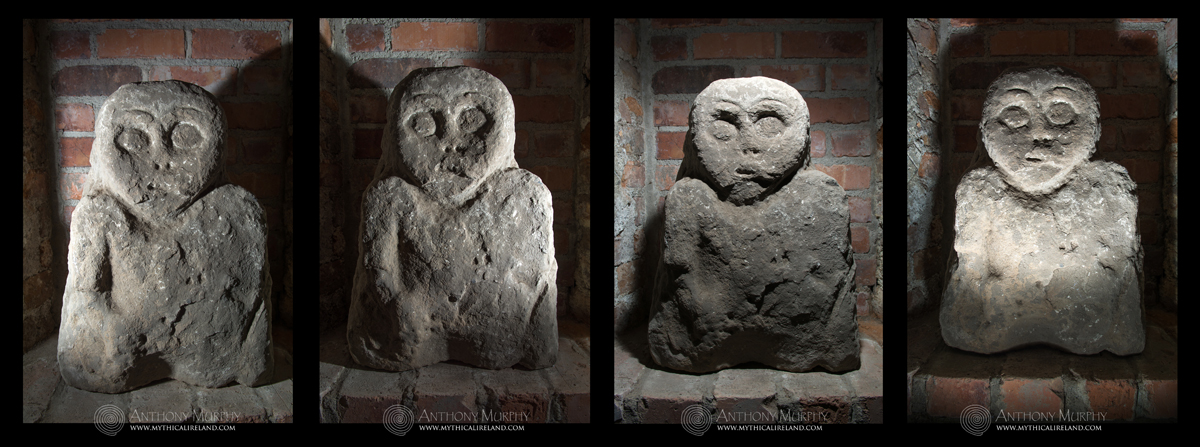
Anyway, regardless of the theories, they are indeed fascinating. Here is a montage of photos I took of the Rosnaree Sheela. In order to capture as much of the detail as possible, I used a remote flash and illuminated the figure from left, right, above and below. Click the image to see a larger version.

Four views of the Sheela-na-gig, illuminated from the left, right, above and below.

Here's a description from the Sites and Monuments Record (SMR) taken from the Archaeological Inventory of County Meath: "Sheela-na-gig now in private possession. Figure formerly built into wall beside door of mill that was not its original location. Removed from wall of mill and kept safe in store. Described by Freitag as a figure, ‘crudely carved on irregular stone slab; widest at bottom part which is cut straight, allowing figure to sit firmly on ground. Elongated, deeply hollowed out groove in crown of head (presumably for libations) further indication of figure originally free-standing. Left side defaced, and some damage also to chin, right forearm, right foot and lower part of leg. Large head, no ears, big owl-like eyes with eyebrows, clearly marked nostrils, jagged incision indicating mouth and possibly teeth. Four striations on right cheek running down to side of slab. No neck or breasts, but clearly marked navel. Right arm reaches under leg which is widely splayed, but no hands or fingers traceable. Genitals indicated by deep semi-circular depression’ (Freitag 2004, 140)."(2)

Recently, a link has been suggested between these grotesque Sheela-na-gig figures and the wife of Saint Patrick, who was called Sheela. The scholar who suggested that link, UCC folklorist Shane Lehane, says the following of the Sheela-na-gigs:
Sheela-na-Gig is a basic medieval carving of a woman exposing her genitalia. These images are often considered to be quite grotesque. They are quite shocking when you see them first.  Now we look at them very much as examples of old women showing young women how to give birth. They are vernacular folk deities associated with pregnancy and birth.

I wish to express my thanks again to the Heise family for making me so welcome and for allowing me the opportunity to see this rare and fascinating relic of the past.

A photo of the old mill house at Rosnaree during winter floods a few years ago.

References:
(1) Sheela-na-gig theories by Tara McLoughlin.
(2) http://webgis.archaeology.ie/historicenvironment/

Saturday, 17 December 2016

The 12 days of Solstice - Day 8 - megalithic art on kerb stone 52, one of three highly decorated kerbs


This is kerb stone 52 at Newgrange, which lies at the rear of the mound, exactly opposite the main entrance kerb stone. It is one of just three highly decorated kerb stones at Newgrange. The others are kerb 1, the kerb immediately in front of the entrance to the passage, and kerb stone 67, on the northeastern side of the kerb.

As you can imagine, interpretation of the symbols carved into stone at Newgrange and its sister monuments over 5,000 years ago is necessarily subjective, and there is a wide range of theories as to what various emblems and designs on different stones mean. My own view is that there's no great harm engaging in speculation - however, one has to be careful about ensuring that the archaeological evidence is not disputed by your theory. For instance, one gentleman I encountered some years ago insisted that symbols on a passage stone at Cairn T, Loughcrew, were figures including the biblical partriarch Jeremiah, sailing on a boat to Ireland. This same individual insisted that Newgrange is an Iron Age construction, and all the archaeologists are wrong about its date!

My own theory (and because it's just a theory, I could be wholly wrong about it) is that it might contain symbols representing Orion and Sirius. At the time Newgrange was built, around 3150BC, the declination of Sirius was -23º 2' 43.1". This means that its rising position would make it visible from the chamber of Newgrange, out through the roofbox. A prostrate observer on the floor of the chamber could have seen this "dog star" (or whatever it might have been called back then) night after night at certain times of the year. However, due to the effects of precession of the equinoxes, a slow wobble of the earth's axis, Sirius's declination was increasing, and over the next couple of centuries it would have drifted northwards, so that it was no longer visible from the chamber.

Some of the engravings on kerb 52 could be interpreted as representations of Orion's belt and Sirius:
On the right-hand side of the stone, there are three sets of three circular holes, known in archaeological terminology as "cup marks". Each of these sets of holes is contained within a double oval-shaped cartouche. There are a number of other cup marks on the stone, the most noticeable of which is one contained inside the vertical stripe in the centre of the stone. Is this Sirius, sitting on the axis of the site, which runs through the entrance kerbstone, K1, up the passage, and out the other side of the kerb in the centre of K52?(1)

Maybe it is, maybe it's not. This is the nature of speculation. But at the very least this theory fits the astronomical evidence and does not dispute the archaeological evidence - always a good starting point!

The presence of the vertical line or stripe on this stone led archaeologists to speculate that there might be another passage behind it. Prof. Michael O'Kelly excavated an area of the mound behind this stone in search of just such a passage, but no evidence of one was found.

References:
(1) Murphy, Anthony and Moore, Richard (2008) [2006], Island of the Setting Sun: In Search of Ireland's Ancient Astronomers, Liffey Press, p.178.

Wednesday, 14 December 2016

The 12 days of Solstice - Day 5 - ribbed stone at the threshold of the chamber of Newgrange

It's day 5 of 'The 12 days of Solstice' and today's image is a photo of passage stone R21, which lies at the threshold between the passage and the chamber of Newgrange. The grooves and ridges which have been formed on this stone by picking remind one perhaps of ribs. On the morning of winter solstice, the sunbeam strikes the bottom of this stone before passing into the chamber.

This highly unusual ribbed stone is not entirely unique. Another passage stone, R12, features three similar grooves. Their meaning is not known. I cannot help thinking of a rib cage, and in particular an obscure myth from the Boyne Valley which may be one of Ireland's original creation myths. It is the story of the Mata, a giant monster that was ripped into pieces and thrown chunk by chunk into the Boyne River. The monster was killed at Brug na Bóinne. The myth seems typical of that cluster of myths around the globe which sees creation preceded by an act of dismemberment, something which leads creation myth author Philip Freund to entitle his chapter about it 'Out of the monster'. In all of these myths, he says, "the cosmos is carved out of some slain monster's body'(1).

In the case of the Mata, its remnants form natural features of the landscape. Note in this passage how it is distinctly stated that the monster was slain on a stone "in" the Brug of Mac Oc (Newgrange):
When the men of Erin broke the limbs of the Matae, the monster that was slain on the Liacc Benn in the Brug of Mac Oc, they threw it limb by limb into the Boyne, and its shinbone (colphta) got to Inber Colptha ("the estuary of the Boyne"), whence "Inber Colptha" is said, and the hurdle (clíath) of its frame (i.e. its breast) went along the sea following the coast of Ireland until it reached yon ford (áth); whence "Ath Cliath" is said.(2)

Mata, which is an Irish word meaning "great, dark, gloomy", was destroyed at Newgrange. He was thrown, in pieces, into the Boyne, where his ribcage (clíab/chléib = of the framework of the ribs) made its way down along the coast and formed the ford of the River Liffey in Dublin.

Another curiosity is the fact that, viewed from the passageway looking towards the chamber, this ribbed stone has the shape of a salmon. The Salmon of Knowledge is an important story connected to the Boyne - to Fiacc's Pool, which is only a short distance upriver, between Rosnaree and Knowth.

References:
(1) Freund, Philip, 2003 [1964], Myths of Creation, Peter Owen, p.61.
(2) Clark and Slover, 1996 [1936], Ancient Irish Tales, p.598.

Monday, 12 December 2016

The 12 days of Solstice - Day 3 - megalithic art on Newgrange passage stone L19 ... guardian stone?

It's day 3 of my series of photographs called 'The 12 days of Solstice' and today's image features a passage orthostat from Newgrange known as L19 and its beautiful megalithic art. The archaeologist, Michael O'Kelly, numbered the kerb stones, the passage stones and chamber stones. The left-hand passage stones were given an 'L' designation, the right-hand ones an 'R' and the chamber stones 'C'. L19 stands out as the most heavily decorated of the passage orthostats.

Many of these passage uprights have little or no decoration. Some are pick-dressed, a technique which basically removes the outer "skin" of the stone. L19 is heavily pick-dressed above and below the zig-zags and spirals seen in this photo. In fact, some of this pick-dressing has obliterated some spirals on the lower part of the stone. We're not at all sure why this was done.

What we do know is that L19, because of this vividly carved decoration,  is one of the stand-out stones of the narrow corridor leading towards the chamber of Newgrange. The arrangement of the three spirals, with a lozenge in the middle, has led to some people referring to the design as a face, perhaps of some deity or spirit. In this respect, it might be seen as a guardian stone.

Saturday, 10 December 2016

Celebrating winter solstice season with a new series of images of Newgrange called 'The 12 Days of Solstice'

The first image from my new series called 'The 12 days of Solstice' shows the corbelled ceiling of the chamber
of Newgrange. This photo was taken with a wide-angle lens while lying on the floor of the chamber. The ceiling
was not disturbed during excavations and is undisturbed. The passage is at bottom, with the recesses partly
visible on left, top and right.


Today begins a 12-day countdown to the Winter Solstice, the shortest day of the year, which is celebrated every year at the 5,200-year-old Newgrange monument in the Boyne Valley. This year, as a special celebration of the solstice season, I am unveiling a set of images - one per day until solstice - based upon the idea of the song '12 Days of Christmas'.

Because the date of Christmas was undoubtedly chosen to coincide with the ancient pre-Christian celebration of the shortest days, I thought it would be a nice idea to do something based loosely around the twelve days of Christmas. However, instead of beginning on the special day, the series of images will be finishing on that day - the Winter Solstice - with the 12th image.

The series of images I have chosen is made almost exclusively of pictures that have never been seen before - with the exception of one. They show various images of Newgrange - interior and exterior - which I hope will evoke a mood of reverence for the ancestors, and perhaps an inclination towards reflection and contemplation about the deeper meanings of Newgrange, and how these might  permeate into our own lives.

For me personally, Newgrange is an extremely sacred and potent place. The idea - propagated in the abundant folklore and mythology of the sacred monument - that it is a liminal place, or point of access to other realms, is something that brings a deeper meaning to what it should represent for us, as individuals, and collectively as a society.

Newgrange functions as a mandala of sorts. It represents a prehistoric society's vista into an all-encompassing cosmology. It represents, symbolically, the earth, but an earth that is connected intimately with the wider cosmos. That connection is dramatically played out on the shortest mornings of the year, when a blade of golden light illuminates the dark cave in an awesome display that provides, for the modern observer, a moment of profound rapture. But it represents, more than anything, an image of hope - hope on two levels. The first is the hope that we can see the light after darkness, in a physical sense and also a psychological and spiritual sense. The other is that there is something beyond this life, something out there, through the "magic window", along the pathway of light, in another realm of existence.

There is much about Newgrange that is mysterious. But, when you've been there often enough, there is much that is hidden in plain sight. The antiquarians who visited the Boyne Valley monuments were, in some cases, undoubtedly looking for treasure - artefacts - things that would perhaps give them wealth and fame. However, the real treasure of Newgrange is far greater than any trinket of gold or venerated object of stone.

The real treasure of Newgrange is that it can serve as a mandala for us. It connects us with ancestors, those to whom we owe our very existence, and whose struggles through the dark periods of life were not in vain. It allows us a symbolic representation of something that is beyond the humdrum of ordinary life - opening a portal for us, perhaps, allowing ingression into sacred and divine realms. Newgrange - because it has endured and is still accessible to this day - offers an opportunity to experience a rapture and an awe, a pure exhilaration at the miracles of our existence, and indeed a space in which to contemplate the deepest of life's mysteries, those which were undoubtedly pondered by the ancestors of the Neolithic.

Where have we come from?
Who are we? 
Why are we here?
What happens to us when we die?

I hope you enjoy this series of images. I am very blessed to have been able to access Newgrange on many levels over the past two decades. I am, in particular, extremely grateful for the permission from the OPW that I have had to photograph its interior on many occasions over the years. I am especially thankful for having been able to witness the solstice illumination of the chamber, back in 2010. It is a very special place. I hope these photographs give you some sense of just how special it is.

Anthony Murphy, December 10th 2016.
(The first day of solstice!)

Thursday, 8 December 2016

Time lapse footage shows dramatic eclipsing of Dowth's solar eclipse symbols on Stone of the Seven Suns


The above video is a time lapse sequence showing the Stone of the Seven Suns (kerb stone 51) as it is lit up dramatically after sunrise in early December, with just two weeks to go to the Winter Solstice. The video features almost half an hour of footage compressed into one minute and 30 seconds. The symbols on the stone are thought to represent the sun, or perhaps even the sun during a solar eclipse, with ties in with the mythology about Dowth which suggests that its construction was abandoned when a sudden darkness fell over the land.

The time lapse footage reveals something fascinating. At first, the solar symbols are lit up quite dramatically, so that they are shown in excellent relief. Then, as the sun rises moves towards the south, a shadow from another kerb stone falls over the sun symbols - eclipsing the symbols one by one. If you can, make sure to watch the YouTube video at 1080 HD and full screen.

Kerb 49 (arrowed) is the one that casts
the shadow on kerb 51. Also shown here
is kerb 50, with its vertical line.
Unfortunately there was cloud blocking the sun early on, so the first of the seven sun symbols, which is on the far left of the stone, is already in shadow when the sun comes out. However, that does not spoil the show. Sit back and watch this marvel of megalithic magic! One can only speculate as to whether this "light and shadow" show was intentional on the part of the builders. The shadow from kerb stone 49, which is two stones to the left of the Seven Suns stone, causes the eclipsing of the symbols on kerb 51. However, it can be seen that kerb 49 leans forward somewhat (K49 is arrowed in the picture on right), and one has to be mindful about the possibility that this lean has happened in more recent times and was not, perhaps, part of the original design.

However, this interaction of light and symbols reminds me somewhat of the illumination of symbols that are not dissimilar to Dowth's seven suns on the back stone of Cairn T at Loughcrew. These symbols are lit up by sunrise on the spring and autumn equinoxes.

The interplay of light and shadow is also suggested at Newgrange, where shadows from the Great Circle stones appear to point towards, or "touch", kerb stones at the front of Newgrange at certain important times of the year, as described by Frank Prendergast.

Although I've been to Dowth several mornings lately to watch how beautifully the sun symbols are illuminated, I hadn't realised the extent of the phenomenon, or the slow progression of the shadow, until I saw the time lapse video. The video was made by taking a photography every two seconds. Because it compresses time, it shows the effect much more vividly.

The sun symbols lit up by the low winter sun. The shadow has not yet eclipsed these emblems.

The shadow crosses the stone diagonally, and interestingly the last sun to remain illuminated is the one which is currently at ground level. I presume the original Neolithic ground level is several inches below the current ground level and that the lower part of this symbol is hidden from view.

At around 9.15am, as shown in the above photo, the shadow from K49 is crossing the diagonal line on K50. Within about 15 minutes this shadow will have completely crossed K50 and will begin its slow progression across K51, eclipsing the eclipse emblems as it does.

The shadow from K49 is almost half-way across K51, the Seven Suns stone.

There is undoubtedly more to be learned about Dowth. It continues to provide surprises. Even though its mythology suggests a summer solstice influence, we can see the midwinter sunrise also has a dramatic "wakening" effect upon the few eastern kerb stones that are revealed. This is by far the best time of the year to view the Stone of the Seven Suns. At most other times, the megalithic art appears to be very flat and is sometimes difficult to see.

We shouldn't forget either that Dowth's southern passage and chamber are aligned so that the light of the setting sun on winter solstice shines inside, as shown in these beautiful photos by Anne Marie Moroney.

Monday, 5 December 2016

Winter sunlight does some beautiful things with the ancient megalithic art on the stones at Dowth

I've been able to spend a few mornings at Dowth recently. It's one of three of the great monuments of Brú na Bóinne (the others being Newgrange and Knowth), but is the least visited of the trio. Personally, I'm glad that Dowth retains this almost-forgotten status. It is not on the official tour. It is wild and overgrown, and many of its secrets are in the deep slumber of many centuries. I like it that way. It's a lovely place to spend time. Despite the fact that it is named after darkness (Irish Dubhadh), it presents a very interesting notion - the belief that we must experience the darkness of the longest night before the new year dawns.

Winter sunrise at Dowth, the third great passage-tomb of the Brú na Bóinne complex.

While it near neighbour Newgrange is famous for its winter solstice sunrise alignment, Dowth's alignment to the sunset on the shortest day is less well known. Discovered (rediscovered) in 1980 by Martin Brennan and Jack Roberts, it was studied in detail over the course of a number of winters by Anne Marie Moroney, who published a lovely little book about it called Dowth: Winter Sunsets.

While the focus at Dowth is undoubtedly centered around winter sunset, there is something really beautiful that happens just after the sunrise on these short days of midwinter. The very well-known kerb stone 51 at Dowth, more famously referred to as the Stone of the Seven Suns (named so by Martin Brennan), is gloriously lit up by the warm luster of the midwinter sun. For about an hour after sunrise, these ancient solar symbols are highlighted in a dramatic fashion by the acute angle of the low sun. As a photographer who has spent many years photographing this stone under various lighting conditions, I can safely say that I have never seen them so impressively and dramatically in relief. It's quite striking. Below are a couple of photos showing some of the megalithic carvings, which are thought to be up to 5,500 years old, lit up by the winter sun.

Some of the solar emblems on the Seven Suns Stone lit up by the low winter sun.
The megalithic art is highlighted in dramatic and pristine fashion by the acute angle of sunlight.

The Stone of the Seven Suns is on the eastern side of the great mound of Dowth. Curiously, over on the southwestern side, the entrance stone to the southern chamber is also lit up by the morning sun in winter time. This is due to the alignment of the stone, which is orientated roughly northwest-southeast. There are two large cup holes on the stone, referred to by some as 'Lucy's Eyes'. There is also some worn megalithic art, which appears to be part of a spiral. A good bit of the stone is still buried beneath the ground - only the top third or quarter is visible above the surface.

The spiral and cup marks on the entrance kerb. I added flash to this one because the sunlight was a bit watery.
For a place that is named after darkness, the sun plays a big role at Dowth. It penetrates the southern chamber at midwinter, as we know. Until recent centuries, it probably also shone into the northern chamber around the time of Samhain and Imbolc sunsets (November/February). And there may be undiscovered passageways within its huge bulk. But as I said before, some of its secrets are in slumber. For now at least. And that's just the way I like it.

See more photos of Dowth.

Wednesday, 24 August 2016

What is the meaning of Knowth's pillar stones?

A large sandstone pillar stands outside the entrance to the western passage at Knowth. The meaning of this pillar, and a similar but smaller one on the eastern side, is not known. They appear to be somewhat phallic in nature, and both are accompanied at a short distance by two large "testes" stones. 
The sandstone pillar and stone settings outside Knowth's western entrance.
At Knowth, the white quartz has been left in situ, on the ground, where it was found during excavations, which is contrary to the reconstruction of Newgrange, where the white quartz found on the ground beneath the cairn slip was once thought to have been on the front of the mound, forming a near-vertical wall, and thus Newgrange has been reconstructed that way. The quartz at Knowth is interspersed with water-rolled granite cobbles identical to those found at Newgrange. The interpretations are different. Perhaps the two monuments were built differently?

Knowth west at equinox. Click to enlarge.
There is no easy explanation for the presence of the pillar stones at opposite entrances. Martin Brennan (The Stones of Time, 1984) has noted the interplay of the shadow from the stone at the western side (pictured above) with a vertical line on the centre of the stone immediately outside the entrance to the passage around the time of the equinoxes, when the sun's light reportedly illuminates the passageway. (It does indeed illuminate the passage, as I witnessed and photographed in September 2000, but the maximum reach of the sun into the passage does not occur for another couple of weeks after this, around October 3rd). The photo on left shows the illumination of the orthostats along one side of Knowth's western passage at autumn equinox. This photo was taken by film maker Grant Wakefield on September 20th 2010.


The eastern pillar stone, visible from the pedestrian footbridge at the entrance to Knowth East.
The stone pillar outside the eastern entrance is much smaller, and is made of a different type of stone. Unfortunately, alterations to the outer portion of the eastern passage in medieval times due to souterrain construction have meant the outer section of this passage has a bend in it, precluding light from travelling into the eastern passage/chamber around the equinoxes. The addition in recent times of a bridge and a concrete door surround (see photo above) have further exacerbated this problem. Is there an argument, I wonder, for the removal of part of the souterrains in order that any possible alignment with the sun be investigated? Could we once again (for the first time possibly in thousands of years) witness the sun illuminating the cruciform eastern chamber of Knowth, in a way similar to the solstice illumination of Newgrange? I live in hope.

It might still be possible to witness and record any interplay between the shadow of the pillar stone (gnomon?) at Knowth's eastern entrance around the time of the equinoxes. One wonders if anyone has ever witnessed such an interplay. Such studies (of both east and west entrances) could prove very valuable in revealing any subtle astronomical functions of these entrance settings. These stones undoubtedly had a purpose and a reason for being there in the minds of the builders. 

Another interesting facet of the sandstone pillar outside the western entrance is that it is quite polished on the side facing the mound - as if it had been rubbed smooth over a period of time. One wonders if there might have been some ritual involving the touching of this stone over a long period of time in antiquity. The story about the Lia Fáil (another phallic or pillar stone) at Tara and how it screamed when the rightful king touched it brings to mind the idea of perhaps many people touching a stone to receive some sort of blessing or luck from it. Perhaps they kissed the stone, like kissing the modern-day Blarney stone? Who knows?

The modern entrance to Newgrange.
Yet another interesting aspect of the Knowth entrances is that, with the preponderance of stones carefully placed and set out in front of these portals, it must be assumed that access into the passageways was not easy, and was perhaps undertaken by only the chosen few? Indeed at Newgrange the only reason tourists can access the passage and chamber today is because (a) the entrance area was widened, and set back from the kerb to accommodate people and (b) wooden steps were installed so that people don't have to clamber over the entrance kerb stones, thereby slowly eroding and damaging them. The entrance is shown in the photo on right (click to enlarge), in this somewhat exaggerated fisheye-lens view. But you get the picture.

A shallow basin-type feature outside Knowth east, replicated on a smaller scale at Knowth west, may have perhaps held water for some sort of ceremony - absolute speculation on my part, but the study of these things is necessarily subjective. Unfortunately, a similar circular-shaped stone setting outside the entrance of Newgrange, in which a stone phallus artefact was found, was removed during excavations and not put back afterwards. Perhaps there were more similarities between these sacred entrances than we might have considered.

One thing that seems clear is that there was an intentional liminal aspect of the entrances. These are boundaries, thresholds. The kerb stones outside Newgrange as well as Knowth East and West are all lavishly designed. Settings of stone on the ground were perhaps associated with rituals held outside the entrances in ancient times. One wonders if the builders of these magnificent structures were to somehow magically venture forward in time to today, would they be delighted, or horrified, to see so many people entering these sacred womb-tombs?

Below is a short video trailer of a film called "Remnants" made by Grant Wakefield. At 0:49s you can see some brief footage of the equinox illumination of the western passageway at Knowth.

REMNANTS - 2k DCP - OFFICIAL TRAILER - 02 from GRANT WAKEFIELD on Vimeo.

Wednesday, 27 April 2016

North Cross, St. Mary's Abbey, Duleek, Co. Meath


Detail from the North Cross at St. Mary's Abbey in Duleek, Co. Meath. According to Peter Harbison, this is the smallest sandstone High Cross in Ireland. It dates from the 10th century.

http://bit.ly/MI-gallery
from Flickr http://flic.kr/p/FJkBMd

Tuesday, 19 April 2016

Three of the Seven Suns at Dowth


Three of the suns on the so-called Stone of the Seven Suns, one of the giant kerb stones at the ancient Dowth passage-tomb in the Boyne Valley, Ireland.

You can buy Mythical Ireland's photos as prints, canvas prints, e-cards, postcards, framed prints and even direct downloads. Visit http://www.mythicalireland.com/gallery.php

from Flickr http://flic.kr/p/Fu4UeB

Thursday, 10 December 2015

Get up close and personal with the entrance kerb stone at Newgrange - without leaving your armchair!


This video shows the entrance kerb stone at Newgrange (known as kerb 1) in great detail, and allows you to view the carvings on the stone without actually having to be there. It was made by the Discovery Programme and the technology used to create the scan was an Artec EVA close range scanner. You can view the stone's famous triple spiral and the other Neolithic carvings in high resolution.

Modern technology is probing the ancient Boyne Valley landscape in ways that the archaeologists of the 20th century could only dream. The above video shows just one aspect of how that is taking place. People in the furthest parts of the globe can see the 5,000-year-old carvings at Newgrange without leaving their home - in fact, without even leaving their armchair.


Thursday, 25 June 2015

Several views of the Seven Suns stone


On Saturday last, the eve of Summer Solstice, my son Luke and I headed out into the Boyne Valley in the hope of getting a photo of the triple conjunction of Venus, Jupiter and the Moon at Newgrange. Unfortunately after the sun set a bank of cloud rolled in, obscuring the triplet before we could get any decent photos. Not to waste an opportunity for a photograph (I rarely do!), we headed to nearby Dowth, where I decided to play around with torches and flashes using my favourite stone-lighting technique – painting with light. You might have seen a previous post from the same night here.

The stone above is famously known as the Stone of the Seven Suns. It was so named by Martin Brennan, an artist and writer who made several significant discoveries about ancient astronomical alignments in Ireland. There are several theories as to what this stone might mean. It is one of just a few stones that are completely exposed. Many of Dowth's 115 kerb stones still lie either partly or totally concealed beneath the earth and vegetation.

I tried to use torchlight and flashlight to illuminate the stone from different angles to show as much of the art as possible. These carvings were made as long ago as 3,300BC and maybe even earlier. In certain lighting conditions, this stone can appear quite flat and the carvings don't stand out. The best time to see it is coming up to midday, with the sun lighting it from the side. Otherwise, a long exposure photograph with a light source from the side, or above, helps to show up the markings very well.

Saturday, 20 June 2015

Circles in stone at Dowth

Dowth kerbstone with circular carvings, illuminated from different angles to highlight the art.
This is a montage of four different images of a kerbstone at Dowth that has a number of circular features carved onto its surface.  I headed out with the camera tonight to try to get a photo of the triple conjunction of the Moon, Venus and Jupiter over Newgrange, but was disappointed when a bank of cloud rolled in before it got dark enough to get a nice shot. Not to waste the journey, I went from Newgrange to Dowth (my son Luke was with me for company) and we decided to try to light some of the kerbstones on the eastern side.

This stone is located two stones to the right of the famous kerbstone 51, the Stone of the Seven Suns. It is better exposed now than in any of my previous visits over the years. Some work has been done in recent time to clear away the grass around these kerbstones, which are fenced off to keep livestock away. Regrettably, whoever carried out the work also cut down a lone bush which had grown over kerbstone 51 a couple of years back.

To try to highlight the four circular features apparent on this stone, I tried to light it from different angles using a technique which I have been fond of for 16 years now which is familiar to photographers as "painting with light". What do these arcane circles represent? We could make many guesses. Given that Dowth's mythology as well as its design are likely connected to the study of eclipses, we could speculate that these are perhaps representative of full moons. Cosmic imagery is plentiful on the monuments of the Boyne Valley, where a community of farmers and astronomers built huge stone structures aligned on cosmic events over 5,000 years ago.

Triple conjunction of Moon, Venus and Jupiter over
Newgrange, pictured in 2012.
While we did not see the triple conjunction in all its glory, we did get a glimpse at the three planets hanging in the evening sky over Newgrange just before the cloud obscured them, and wondered what our ancient ancestors would have made of such a sight all those millennia ago.

Fittingly, as Dowth's Irish name, Dubhadh, means "darkness", it became pretty much completely overcast as we photographed its stones . . .

Sunday, 14 June 2015

Knowth kerbstone 83 - natural and man-made holes


This is kerbstone 83 at Knowth – or, if you prefer Martin Brennan's numbering system (which I don't), kerbstone NW9. Professor George Eogan, who excavated Knowth, refers to the style of art on this stone as the "lavish style". He does not offer any further insights into what the carvings might mean. Who can blame him? Brennan suggests the mixture of natural holes and cupmarks "seem to provide a starry background" to lunar imagery. This is indeed a peculiar stone. It's got a series of natural holes and linear markings (maybe a geologist can tell us what they might be called) and engravings that are mostly crescents, with some concentric circles centred around what might be a natural solution hole. There's also a spiral and a wavy line. A very long linear marking across the middle of the stone appears to connect a series of crescents on the far left with a "wavy line" as Brennan calls it, on the right. Curiously, a series of five natural holes (at least they look natural and not man-made) between the spiral and the wavy line appear to be enclosed within a cartouche. One wonders why. The stone is unique in having such a conglomeration of natural features and man-made designs.

Thursday, 11 June 2015

Heaven's mirror - as above, so below at Knowth


The interpretation of megalithic art is a highly subjective area. I have a tendency to go along with some, but not all, of Martin Brennan's interpretations, and am particularly impressed with his interpretation of what he calls the Calendar Stone. This does not mean I am an absolute convert to the notion that all of the Neolithic symbolism carved on stones in the Boyne Valley is cosmic or astronomical in nature. I like to observe and to admire the art, and in some cases to interpret it in the context of astronomy. But what works for the interpretation of one stone does not necessarily transfer to other stones. There's so much art - particularly at Knowth, where one is constantly impressed by the sheer amount of petroglyphs that one wonders how many different people were responsible, and over what span of time. I've been going there for years, and I still stand in awe at this massive megalithic art gallery, grafted carefully and lovingly all those millennia ago.

The above kerbstone is kerb number 86 (according to Professor George Eogan's numbering convention, which we'll use for convenience). It is located on the western side of the kerb, a short distance north of the dramatic and cryptic entrance to the western passage.

So what do I see?

Do I see the C? The opposed Cs, as George called them?

Well, kind of. But I don't think like an archaeologist. So I dislike the simplicity and arbitrary nature of labels like "opposed Cs". I don't think the people who carved them thought of it that way at all.

So what do I see? Do I see what I want to see? Perhaps.

As an astronomer, I might see crescents; crescent moons. And I believe the moon is everywhere in megalithic art. But no, in this stone I see more than that. Here follows my (very subjective) interpretation - and remember that the tour guides at Newgrange tell you that you can all have your own theory, and that everyone's theory is as valid as anyone else's. So here is my just-as-equal-as-yours theory about kerbstone 86 at Knowth:

I might see the arc of heaven. I might see the Milky Way, in all its glory, stretched in a spectacular arch across the ceiling of night, in the beautiful ancient Boyne Valley under the darkest of skies, unpolluted by the choking fumes of modern industry and transport, and unhindered by the artificial light with which we so alienate ourselves from the cosmos today. And I might see this milky road of the stars, this bright way of the heavens, reflected on earth by the Boyne river, which loops magnificently around the great monuments of Brú na Bóinne. Did the ancients think this way? Did they think cosmically? Did the monuments somehow proclaim their tiny place of presence and permanence in a vast cosmos?

In olden times, the Irish for the Milky Way was Bealach/Bóthar na Bó Finne - the Way/Road of the White Cow. The Boyne river is from Bóinn - Bó Finne - the river of the White Cow. The names of the river on earth and the 'river' in the sky had a similar derivation.

Do these carvings on kerbstone 86 at Knowth represent the idea of Heaven's Mirror - As Above, So Below? Is the sky reflected on the ground? Is the line in the middle representative of the demarcation, the liminal boundary between heaven and earth? All of the symbols are enclosed in a sort-of great cartouche, perhaps an indication of the cosmos as an entity with limits - something that ends where the stars are fixed, where the souls go after we gently place their remains in the stone chambers, perhaps?

Or is this stone's symbolism representative of opposed worlds (or even mingling worlds) rather than opposed Cs? The sídhe (mounds) were considered access points through which the Tuatha Dé Danann could pass between worlds - between this world and the otherworld:

And as to Angus Og, son of the Dagda, sometimes he would come from Brugh na Boinn and let himself be seen upon the earth,

Underworld, overworld. This world, the otherworld. Earth, heaven. Ground, sky. Conscious realm, subconscious realm. Reality, fantasy. Fact, theory. Objective, subjective. Tourist, tour guide. Tomb, womb. Decoration, language.

Say what you C. You are unlikely to be proven wrong. But have a go at interpreting it. Because if you don't, someone else will. Someone else will C what you don't C ...