Thursday, 10 December 2015

Get up close and personal with the entrance kerb stone at Newgrange - without leaving your armchair!


This video shows the entrance kerb stone at Newgrange (known as kerb 1) in great detail, and allows you to view the carvings on the stone without actually having to be there. It was made by the Discovery Programme and the technology used to create the scan was an Artec EVA close range scanner. You can view the stone's famous triple spiral and the other Neolithic carvings in high resolution.

Modern technology is probing the ancient Boyne Valley landscape in ways that the archaeologists of the 20th century could only dream. The above video shows just one aspect of how that is taking place. People in the furthest parts of the globe can see the 5,000-year-old carvings at Newgrange without leaving their home - in fact, without even leaving their armchair.


Tuesday, 8 December 2015

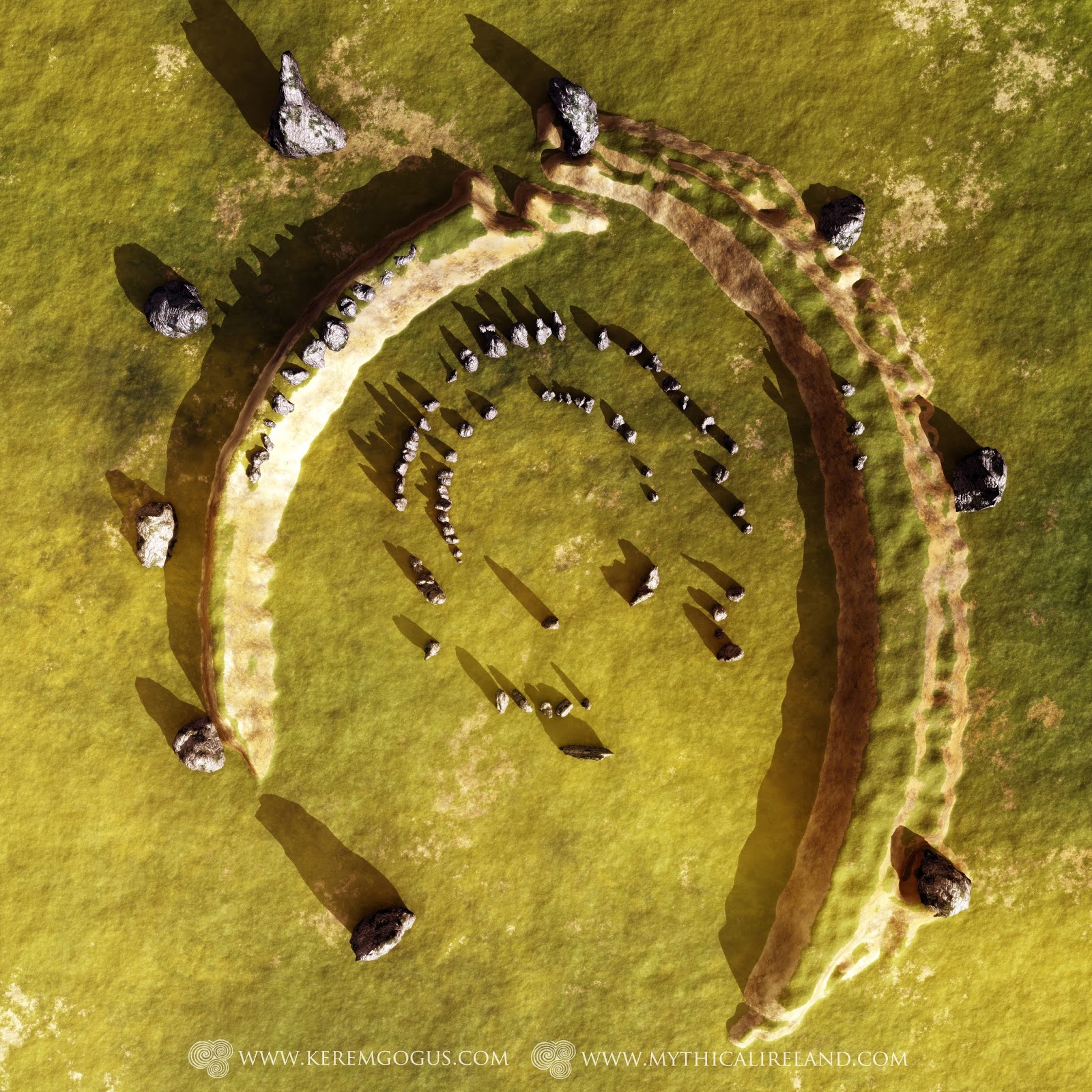
Fabulous new 3D images by Kerem Gogus show Ireland's Stonehenge as it might once have been

A new depiction of Ireland's Stonehenge at sunset around midwinter, by 3D artist Kerem Gogus.
I am delighted to unveil new 3D-generated images showing Ireland's Stonehenge as it might have looked, created by 3D artist Kerem Gogus. These new images are based upon the only known depiction of a lost monument - a magnificent structure that probably dated to the Stone Age and could be considered Ireland's equivalent of Stonehenge - sadly now destroyed. The only drawing of this great embanked structure of concentric stone circles was made by the antiquarian and astronomer Thomas Wright, in the 1740s. Since then, the monument was destroyed, such that it was thought to have been lost completely until its "footprint" was found on an aerial photo of the Carnbeg area outside Dundalk, Co. Louth, in 1988.

The monument at Carnbeg brought to
life by in this new image by Kerem Gogus.
With only Wright's drawing to go on, Kerem made a couple of images about a decade ago showing what the stone monument might have looked like. But this week, following my revelation that some of the largest stones of the monument might actually be buried beneath the soil where they once stood, the Dundalk Democrat newspaper wanted to do an article about this discovery. Their reporter Ian Cameron contacted Kerem and he agreed to make new images, which give us the first conceptual overview in high resolution of how this monument might have looked if we could transport ourselves back in time. The images give us a unique glimpse at a unique monument. As a result of Kerem's fantastic work, we are able to visualise this once dramatic man-made construction.

The monument consisted of two concentric stone circles surrounded by an embankment with a ring of huge stones outside.
Here is an extract from the article in this week's Dundalk Democrat newspaper about the monument:

Thomas Wright's 18th century drawing
of the monument.
While doing research over the years, he [Anthony] read that some of the smaller stones were taken away and used as gate posts. He believes it should be possible to locate even some of these in the area. Old stone gate posts are easy to spot and quite rare these days. Other smaller stones were sadly broken up to be used as material for roads. The Armagh road (now known as the R177) effectively cut through the site.
“The road was not there in the 1740s when Wright made his drawing. As far as I can ascertain, this road was built in the 1750s (maybe some of your readers might have more information about the exact date of construction?) and would undoubtedly have led to the part destruction of the monument.
Dundalk Democrat's article.  
“For years, I've believed that all of the stones were either removed or broken up. But I've discovered a source (Bassett's Louth Directory from 1886) that says some of the larger monoliths (all but one) were buried: ’Most of the rest were dropped into holes sunk behind them, and covered at a sufficient depth to escape the plough’. For me, that's very exciting news. It means there's a possibility that the largest stones - at least some of them - are still there. It might be possible, using archaeology, to ascertain how many are still there, and there's even the tantalising possibility of discerning potential solar and lunar alignments of the site, which was described in the early 20th century by historian Henry Morris as having been an ancient 'school of astronomy'."
Anthony also believes the site could present a viable and successful tourist attraction for Dundalk once it has been fully investigated and potentially restored.

Another of Kerem Gogus's wonderful new 3D images showing what Ireland's Stonehenge probably looked like.

Monday, 7 December 2015

Newgrange and the return of the Tuatha Dé Danann

I wake up some days and I wonder what we started when we left the forests and turned away from the hunter-gatherer lifestyle towards organised agriculture and monument construction. It was the beginning of modern civilisation, and perhaps the beginning of real conflict between humans. It was a brave but perilous step, emerging from the woods, and clearing land so that we could state in stone and earth something of our cosmology and our spirituality and of our meagre understanding of the great metaphysical mysteries. These questions do not have a time frame. They are relevant today just as much as they were in ancient prehistory:

Who are we?
Where did we come from?
Why are we here?
Where is here?
What is out there?
Why do people die?
What happens to us when we die?

Sunlight enters Knowth's western passage at the autumn equinox.
I've come to believe that the stone monuments of the Neolithic embody those questions. Their construction was an attempt at understanding - or at least attuning to - some of these mysteries. The mythology of the great monuments of Newgrange and Dowth speaks of the desire to control time on behalf of the gods or kings. If you could measure time, and elucidate some of the complex patterns of the sky, perhaps you could open a vista into deeper mysteries.

There has been a lot of speculation - some of it valid - around the idea of monuments as portals. Do passage-tombs such as Newgrange offer access to hidden realms - realms of consciousness or spirit? Realms of the gods? Detached from the sense world, in the darkness of the interior of Newgrange, do you hallucinate, seeing the geometric shapes that are carved onto the stones of the monument? Trance-like, do you meet the ancestors?

In ancient times, people brought the fragmented remains of their ancestors into these chambers and carefully, lovingly, placed them there in the obvious hope that out of their remains would spring new life - perhaps a life eternal, in other realms. These realms are spoken of in mythology.

In the myths, the gods wage war against each other. There are two battles of Moytura. Eventually, in the second battle, the "good guys", the Tuatha Dé Danann, win out against the "bad guys", the Fomorians. When you witness the magic of the winter solstice light in Newgrange - as I have done - and you see that beam of sunlight piercing the darkness, you begin to realise that that was what the journey of the ancient world was all about. It was about the defeat of darkness by light.

Winter solstice light in Newgrange. © Paul Kelly.
But the light of the Tuatha Dé Danann waned when the Milesians came from Spain. The Tuatha Dé Danann went underground, so to speak, agreeing to occupy the sídhe while the Milesians took sway over Ireland. They weren't defeated as such. They made an accord with the Milesians and vanished into the sídhe. But this was not their defeat, nor their end. In accessing the sídhe, those portals to other realms, they were guaranteeing their survival. And the lasting folklore of the Tuatha Dé Danann is that they will return. In fact, some folk prophecy states that they will return for one last great battle, some end-of-the-world scenario, some apocalypse, and that they will be victorious.

So what does all this mean in practical terms, if anything? Were the rumours of a coming return of the Tuatha Dé Danann (and sometimes other great mythical and historical figureheads, such as Fionn Mac Cumhaill or Gearóid Iarla) founded upon the wishes of a repressed and depressed people - an Irish population that had been beaten, downtrodden and starved by centuries of cruel occupation? It is likely that that is part of the tale.

However, there is something about these people of light that makes them endure and endear. They represent our hopes for a better world, those unquenchable hopes that, out of darkness, light will spring. We imagine the return of Lugh Samildánach to Tara, or we envision Aonghus Óg emerging from the great sídhe of Brugh na Bóinne, to reveal himself once more to the world. We should not lightly discard mythology as mere fairy tale. Joseph Campbell said: “Myth is much more important and true than history.” Myth offers a window into the human spirit, our core nature. We venerate the Tuatha Dé Danann(1) as manifestations of our light and compassionate aspects, those facets of our being with which we would bring about a peaceful, harmonious and just world, where the very best aspects of humanity would be allowed to flourish. Equally, we acknowledge the presence of the Fomorians, as manifestations of our tyrannous and malevolent aspects, those facets of humanity that would see the world destroyed and allow human suffering to endure. In world myths, the conquest of darkness by light is a recurring theme. This is unsurprising. The myth with light versus darkness at its core is an enduring myth of hope - hope that we will vanquish the dark side of our nature once and for all.

Newgrange before excavation, when the
light could not reach inside.
Newgrange slept for four millennia - its kerb and entrance concealed by the stones which slipped down off the cairn and sealed it shut. It was "reawakened" in 1699 when the entrance to its passage was rediscovered, and more significantly in the 1960s when it was excavated and its solstice alignment and illumination revealed to the world. Now, hundreds of thousands of people visit the monument every year. The Tuatha Dé Danann are reawakening.

But let us not make the mistake of creating a religion out of the Tuatha Dé Danann. Let us not make them gods or messiahs. Rather, let us make them symbols or metaphors for the reawakening of our own best aspects. In the constant turmoil of a sometimes baffling human existence, where we do the most horrendous things to one another, let us acknowledge that the power to bring about positive change lies entirely within. To create gods of the Tuatha Dé Danann is to engage in a circumvention of our own power, a cop-out in which we declare that the gods have the power, and that they control our destiny.

The truth of the mytho-prescient folk belief in the future return of the Tuatha Dé Danann is that we should not wait at the doorways of the sídhe for the unlikely emergence of some spectral forms in our desire to prevent a cataclysm. Joseph Campbell also said, in The Power of Myth:
“Heaven and hell are within us, and all the gods are within us. This is the great realization of the Upanishads of India in the ninth Century B.C. All the gods, all the heavens, all the world, are within us. They are magnified dreams, and dreams are manifestations in image form of the energies of the body in conflict with each other. That is what myth is. Myth is a manifestation in symbolic images, in metaphorical images, of the energies of the organs of the body in conflict with each other."
In choosing to allow the Tuatha Dé Danann to manifest within us, we are saying yes to heaven and no to hell. We are inviting the metaphorical image of light to transform into a practical reality, a living embodiment of our own goodness, so that we might prevent the Fomorian forces of darkness from bringing us to the brink of destruction.

Newgrange, with its reconstructed portal, reminds us that the
light can and will return.
The prophecy of the re-emergence of the Tuatha Dé from the sídhe should come as no surprise. In a world where darkness often appears to get the upper hand, we need Newgrange to serve as a reminder that the light can and will return - gloriously - and that the darkness is not unending. Imagine that for centuries, and more likely millennia, the winter solstice light was unable to enter Newgrange, because its structural stones had slowly subsided under the weight of the cairn, and the light was cut off. And yet, 5,000 years after it was first constructed, a miracle happened - the light began to shine brilliantly in the cold interior of the monument once again. So too will a miracle happen with the Tuatha Dé Danann. Countless centuries after they retreated to the sídhe, they will re-emerge. This is a metaphorical miracle - our own good nature must re-emerge, and as a species we must find a way to get along with one another. What other choice do we have? In a world constantly under threat from the forces of darkness, should we just retreat to hidden realms and allow the darkness to abide without challenge?

With Newgrange reconstructed, the portal is now open. It is up to us to call the Tuatha Dé Danann from the sídhe, to make them manifest within us, to ensure that, as the prophecy states, they will be victorious.

(1) It should be said here that the mythology of the Tuatha Dé Danann is not all filled with goodness. There are battles, and murders, and there is retribution (for example, the Fate of the Sons of Tuireann). However, in a broad sense, the Tuatha Dé Danann are seen as beings of light, and because of the complexity of themes in their story, especially those involving retreat and hibernation for some future awakening, we judge them as the best representation of our hopes for the re-emergence of goodness within us.

(Note: This blog post is a development of some of the themes explored in this previous post).

Monday, 30 November 2015

Ceremonial dismemberment and excarnation in prehistoric Ireland - a different way to treat the dead

For a while, I've been wondering about how the small human bone fragments that have been found in some Irish passage-tombs came to be in such a fragmented condition. In terms of the unburnt bone human fragments found during the O'Kelly excavations at Newgrange, "apart from some complete hand and foot bones, all human specimens consisted of small fragments". (O'Kelly, Newgrange: Archaeology, Art & Legend, Thames & Hudson, 1982). 
Replica of basin stone from Knowth's eastern chamber with bone fragments.
There were a total of 750 unidentifiable fragments. The fragmented remains of dozens of individuals were found in the chambers of nearby Knowth. Layers of fragmented remains were found in the passage and chamber of Fourknocks. So how do human bones - those that are not cremated - become so fragmented?

Searching through my extensive archive of research material, I found an interesting article from the Sunday Times from July 2003. Eileen Murphy of Queen's University Belfast had studied Irish neolithic bones and found that our early ancestors had dismembered and defleshed their dead. Murphy had worked on the excavation of graves in Aymyrlyg graves in Siberia, Russia.

There she learnt to look for the tell-tale signs of what is thought to have been an ancient religious practice - short, fine scraping marks on the bone and cuts where tendons and ligaments were joined.
"After studying the dismembered and refleshed Russian remains, I decided to have another look at Irish neolithic bones. It is something that has been overlooked before and will now require a reassessment of our understanding of these ancient burial sites.
The researchers from Queen's made the findings when examining bones from the 4,000-year-old Millin Bay tomb in County Down, and the discoveries mirrored those found by Swedish archaeologists at Carrowmore in Co. Sligo. The Sunday Times article described how body parts, notably skulls, are thought to have been kept on display for religious purposes.

Gabriel Cooney, professor of archaeology at University College Dublin, told the newspaper:

In these tombs you rarely find single skeletons, but rather groups of cremated remains. In this way these neolithic people would seem to have been creating a new identity from their treatment of the dead. You also find different parts of the body treated in different ways, such as unburnt parts of the skull in with cremated remains. This would point to dismembering of the corpses.
Were the Brugh na Bóinne bones defleshed by humans or
by the process of natural outdoor excarnation?
Not all corpses were dismembered by other humans. The process known as excarnation, or defleshing , is well documented. This involves leaving the human corpse out in the open (sometimes known as sky burial), or in a cave, for the elements and wildlife to assist in the process of speedy decomposition and dismemberment. Some "excarnation sites" were outdoors, while others were in caves. It is estimated that a human corpse left out in the open can be reduced to a pile of bones in a matter of weeks or months. However, there seems to have been a deliberate effort made, in some cases, to slow down the process of excarnation by leaving a corpse in a cave.

A chance finding of a bone fragment in a cave at Knocknarea in Sligo led to the discovery of more bone fragments belonging to an adult and a child which may have been evidence of cave excarnation. Radiocarbon dating put the age of the bones at over 5,000 years old. It is thought that the process of excarnation in a cave took much longer - perhaps up to two years - but eventually the deceased's relatives would come back to collect the bones for burial elsewhere. In the case of Knocknarea, this burial might have taken place in one of several monuments on the top of the mountain.

We can imagine, therefore, that Stone Age people in Sligo between 5,000 and 5,500 years ago carried the corpses of their dead up the mountain. After an arduous climb, they then squeezed through the narrow cave entrance, and laid the dead person on the cave floor. (Source)

What's also interesting in Ireland is that osteoarchaeological analysis has revealed an absence of animal scavenging marks, suggesting that the entrance to the excarnation caves was sealed during the process of soft tissue decomposition.

This reveals a conscious decision not to speed up decomposition . . . By creating a protective environment in which excarnation took place undisturbed, people controlled the process, pace and space. The living may have sought to observe the slow and gradual disintegration that was taking place inside a cave. The underground was therefore a place of transformation, which in turn transformed caves as places. It may have been in caves that the journey into the spirit world commenced. (Dowd, Marion, The Archaeology of Caves in Ireland, Oxbow Books, 2015, p. 106)
Flint blades from Newgrange - were these used in the defleshing process?
There are no caves in the vicinity of the great passage-tombs of the Boyne Valley. It would be interesting to postulate on how the fragmented unburnt remains there - and indeed at nearby Fourknocks - came to be in that condition. Of course another question that begs to be asked is how many of the flint scrapers and other flint tools found at Newgrange and other passage-tombs were used in the defleshing of human remains . . .

Friday, 27 November 2015

The huge monoliths of Ireland's Stonehenge were buried

Monument was thought to have been completely destroyed some time between 1748 and 1907

However, some of its largest stones might have been buried


For years I have been drawing attention to a monument, sadly destroyed, which has been dubbed 'Ireland's Stonehenge'. This was a remarkable and unique monument consisting of several concentric circles of stone, surrounded by a large earthen embankment, all of which was encompassed by ten enormous monoliths.

Ireland's Stonehenge was documented by antiquarian and astronomer Thomas Wright in 1748. His drawing is the only known representation of this once great monument, which was located in a townland known today as Carn Beg, not far from the town of Dundalk, in the north of County Louth. I first wrote about Ireland's Stonehenge in 'Island of the Setting Sun' in 2006.

A 3D recreation of the stonehenge (right) by Kerem Gogus.
This huge monument vanished from existence some time between Wright's drawing and brief description of it in 'Louthiana' (1748) and the construction of the Drogheda to Portadown section of the Dublin-Belfast railway line in 1855. Historian Henry Morris, writing for the County Louth Archaeological Journal (CLAJ) in 1907, gave us a tantalising insight into what the monument's purpose might have been when he wrote: "I have read or heard it stated somewhere that this place was the site of a school of astronomy. Its position on the plain, with a semicircle of mountains around would enable an ancient astronomer to observe and mark the places where the various heavenly bodies appeared on the horizon at different times of the year." Regrettably, Morris was unable to recall the source of this valuable detail.

Wright's all-too-brief description of this remarkable monument, from Louthiana.
Not long after Wright's drawing was published, the Armagh Road was built, probably in the 1750s, and there can be no doubt that this was a significant factor in the destruction of the stone henge. I overlaid Wright's drawing of the monument on to Google Earth imagery of the site and this makes it obvious that at least some of the monument was flattened for the purpose of the new road.

A crop mark of the monument on
a CUCAP photo from 1970.
I remember reading somewhere (although I cannot now recall the source) that the smaller stones were taken away and either broken up to be used as foundation material for roads, or were used as gate posts. Henry Morris could find no remains of the monument in 1907, saying that it was "Gone! Cleared away, its very site not exactly known". (For much more information, and sources, see Island of the Setting Sun - In Search of Ireland's Ancient Astronomers, chapter 5, 'The Giant Rings'.)

It wasn't until 1988 that the exact location of Wright's druidic temple was finally rediscovered. Archaeologist Victor Buckley was able to discern the monument's "footprint" in an aerial photograph which had been taken in 1970 for the Cambridge University Collection of Aerial Photographs.

There was some archaeological resistivity was carried out at the site in 2006, in advance of a proposed housing development which never happened once the Irish economy collapsed. Standing at the site, which is now part of a disused golf course attached to a hotel, it is very difficult to get any sense that it was anything other than a field. There are simply no stones remaining. None.

However, I've recently discovered something significant about what might have happened to the large stones - or at least some of them - in the most unlikely of sources.

Reading George Henry Bassett's 'Louth County Guide and Directory (1886), we find that early on, he makes reference to the area's antiquities:
The remains of antiquity are very numerous, and extend through every part of the county. They continue in very much the same condition that they were found more than one hundred and twenty-five years ago by Thomas Wright, author of Louthiana. His work was instrumental in stimulating the curiosity of many of the residents of the county in regard to the precise nature of the contents of the Danish and Irish forts and Druidical camps.
In this work in progress, digital artist Kerem Gogus has fantastically recreated
Ireland's Stonehenge in 3D based on Thomas Wright's 1748 drawing.
And here comes the most valuable information pertaining to what happened this once marvellous monument:
It had not the effect, however, of preventing a tenant, near Dundalk. from effacing the Druidical circle at Ballynahatna. Of the ten stones which were said to represent the generations from Adam to Noah, only one now stands in the original position. Most of the rest were dropped into holes sunk behind them, and covered at a sufficient depth to escape the plough.
This is most interesting. Bassett says that instead of bring broken up, like the smaller stones, the large ones were dropped into huge holes to bury them. This is quite exciting as it leads to the possibility that at least some of these large megaliths are still there - buried where they once stood. Perhaps this is information which might lead archaeologists towards further investigation of the site at Carnbeg?

Further reading: Ireland's Stonehenge

Note: I am indebted to Kerem Gogus, the 3D artist, for all the effort he put in to recreating Ireland's Stonehenge so that we might get a better sense of what it looked like. Visit his website here:

http://keremgogus.com/

Thursday, 26 November 2015

The Field Names of County Louth and Meath

I was delighted to receive a copy of The Field Names of County Louth as a gift today. It joins my copy of The Field Names of County Meath as part of my ever-expanding reference and research library. These are both high-quality, comprehensive publications.

My copy of The Field Names of Louth, received today, alongside the Meath book.
Many fields in Ireland have names. These books are the culmination of a long period of research and fieldwork. As the preface of the Louth book suggests, "a  wealth of information not previously recorded and in danger of being lost in the sands of time has been gathered by our labourers in the field".

Here I will give you just a flavour of this wonderful tome, from a little section about Fairies:

The fairies are an enduring feature of Irish folklore. The Irish word for the fairies, sí, originally meant a mound. The sí inhabited a timeless otherworld, but they could slip between that world and this one when they so desired. There has been a long association with the fairies and natural hills, as well as prehistoric cairns and burial places (Ó hÓgáin 2006, 206). Three local versions of the name 'fairy hill' were recorded by the LFNP. They are Cruk Shee (Cnoc Sí) in Knockatober, Crogh Shee (Cruach Sí) in Baltrasna, and Crockshee (Cnoc Sí) in Haggardstown. This latter example is in fact an Anglo-Norman motte castle. Hills and mounds associated with the fairies often are sites of supernatural occurrences, like strange music.

Wednesday, 25 November 2015

Awaiting my salvation in Fiacc's Pool beneath Rosnaree

The following is from a chapter I wrote recently for a book that I've started writing, about Irish mythology and in particular the myths concerning the great monuments of Brug na Bóinne near where I live. The exploration sometimes has a personal and philosophical nature which reflects my interaction with the myths of the Boyne Valley. These myths have become a source of fantastic and all-pervading influence and inspiration in my writing.

----------------------------------------------------------------------------------

Dramatic skies over Brug na Bóinne.


Bless me father, for I have sinned.

What is your sin?

I have forgotten the old ways, the ways of my ancestors.

The old ways are dead, my son. You must learn the new ways.

The old ways are not dead. They are merely sleeping, in the belly of a fish that swims beneath the nine hazels of Segais. I will wade out into the water now, towards Fiacc’s Pool, and there await the coming of my salvation.

No-one can come to the Father, except through me.

I do not wish to come to the Father. I wish to come to myself. I wish to some to myself through imbas, and to know myself in a way that I have never known myself. I will wait for the salmon, at Fiacc’s Pool. And in the dim Wood of the King beneath Rosnaree, I will become Finn, wanting to be with my ancestors at Brug na Bóinne. And Finegas the wise will teach me poetry beneath Knowth, while we wait for the Bradán Feasa.

I cannot help you any more.

Thank you for trying.